How can agricultural policy support healthier people, animals and environments while strengthening the resilience of Europe’s agri-food system?
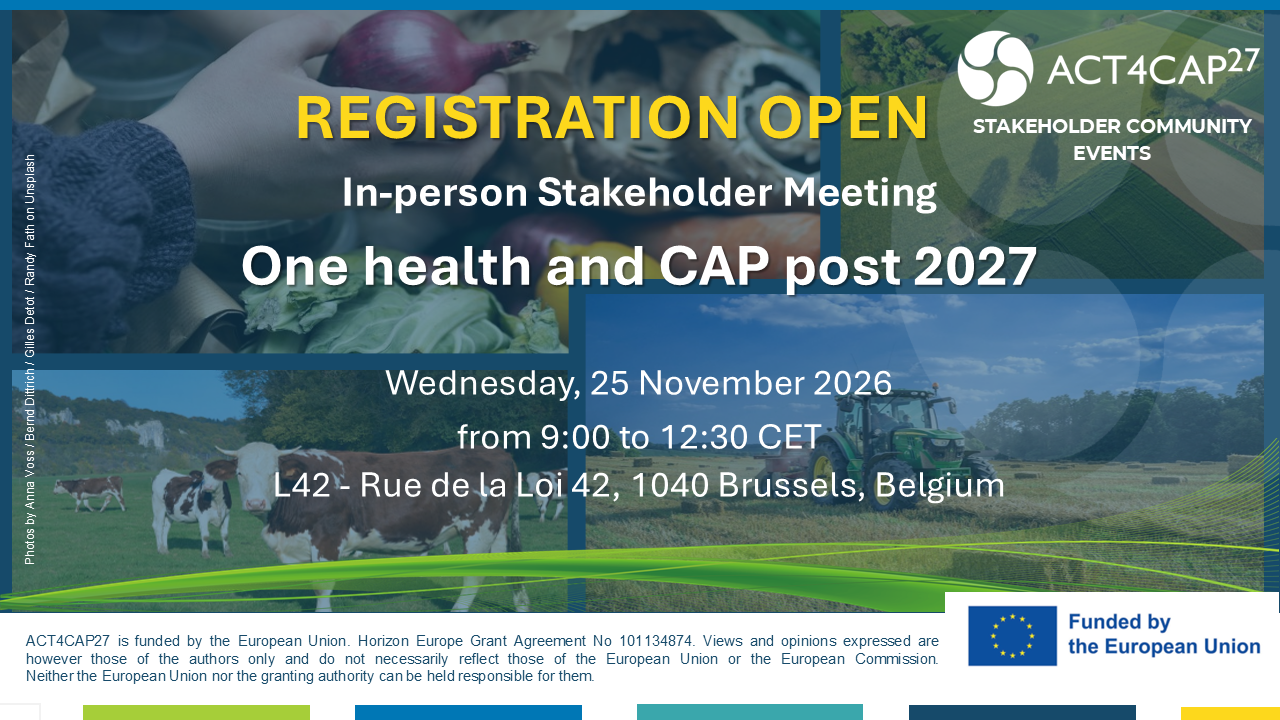
We invite policymakers, researchers and stakeholders to join our in-person ACT4CAP27 stakeholder meeting on 25 November 2026 in Brussels, where we will present recent modelling developments and discuss how evidence on air pollution, antimicrobial use and consumer diets can inform agricultural policy choices after 2027.
Agricultural policy decisions have implications that extend beyond farm production and market performance. Farming practices can affect air quality and environmental pressures; antimicrobial use connects livestock production with animal health and the challenge of antimicrobial resistance; and consumer dietary patterns influence demand for agricultural commodities, with consequences for markets, farm incomes and public health. Understanding these connections is essential to assessing the wider implications of future policy options.
At this meeting, we will explore these relationships through a One Health perspective, connecting human, animal and environmental health within the development of evidence and modelling approaches for the Common Agricultural Policy (CAP) post-2027. We will present recent developments in the ACT4CAP27 modelling work, explain how feedback from our November 2025 stakeholder meeting has been incorporated, and invite participants to help refine the approaches and their relevance to future policy analysis.
The programme will address three interconnected questions. How can agricultural support and farming practices be assessed in relation to air pollution? How could a fee on antimicrobial products affect antimicrobial use and agricultural production across the EU? And how can food-intake surveys and market data be combined to improve the representation of consumer diets in agricultural economic models? The presentations will draw on the MAGNET and CAPRI modelling frameworks and on approaches to integrating dietary evidence into agricultural market analysis. Each session will include time for questions and discussion, giving participants an opportunity to challenge assumptions, share expertise and identify issues that deserve further attention.
These questions connect directly with wider European policy discussions about the future of agriculture and food. The upcoming EU Agri-Food Days on 8–9 December 2026 will focus on building resilience across economic, environmental, digital and social dimensions. Our stakeholder meeting contributes to this debate by examining how agricultural production, environmental conditions and public health interact, and how these relationships can be represented when assessing future policy choices. Resilience depends on understanding these connections, including the potential trade-offs and co-benefits that different policy approaches may generate.
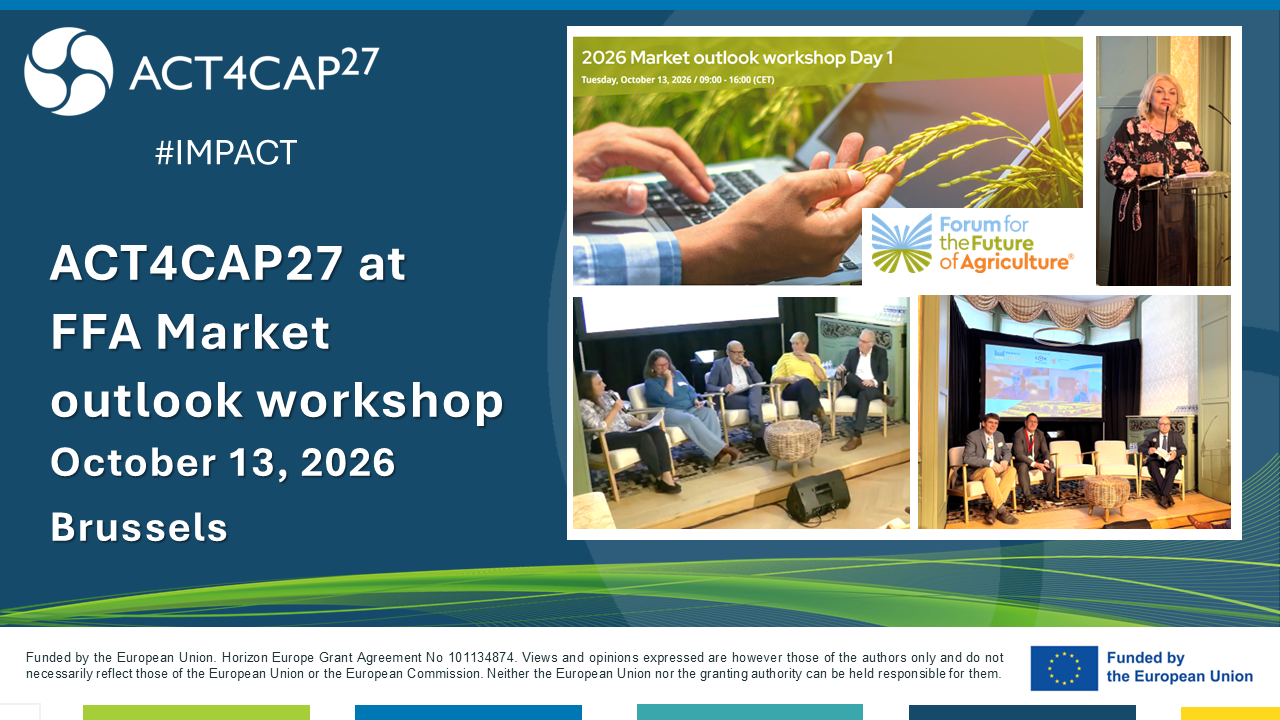
Recent discussions at the Forum for the Future of Agriculture’s 2026 Market Outlook Workshop have also highlighted the challenge of preparing European agriculture for an increasingly uncertain future. The OECD-FAO Agricultural Outlook 2026–2035 projects continued growth in global agricultural production, alongside persistent environmental pressures and exposure to geopolitical disruptions. The workshop’s broader message was that baseline projections are useful reference points, but they cannot capture every possible disruption or policy response. Scenario-based modelling can help explore how different assumptions and interventions may affect agricultural production, markets and wider outcomes. ACT4CAP27 applies this approach to policy questions that also encompass health, environmental quality and consumer behaviour.
The meeting builds on the questions we brought to the EU AgRI 2040 Conference in Brussels, where we presented four What happens if…? policy scenarios. Two are particularly relevant to the One Health discussion: What happens if biodiversity goals become more ambitious? and What happens if Europeans eat less sugar?. These scenarios illustrate how environmental ambitions and changes in consumption can have consequences across agricultural production, land use, trade, markets and farm incomes. They also demonstrate why policy questions involving health or the environment need to be examined alongside their wider economic and agricultural implications.
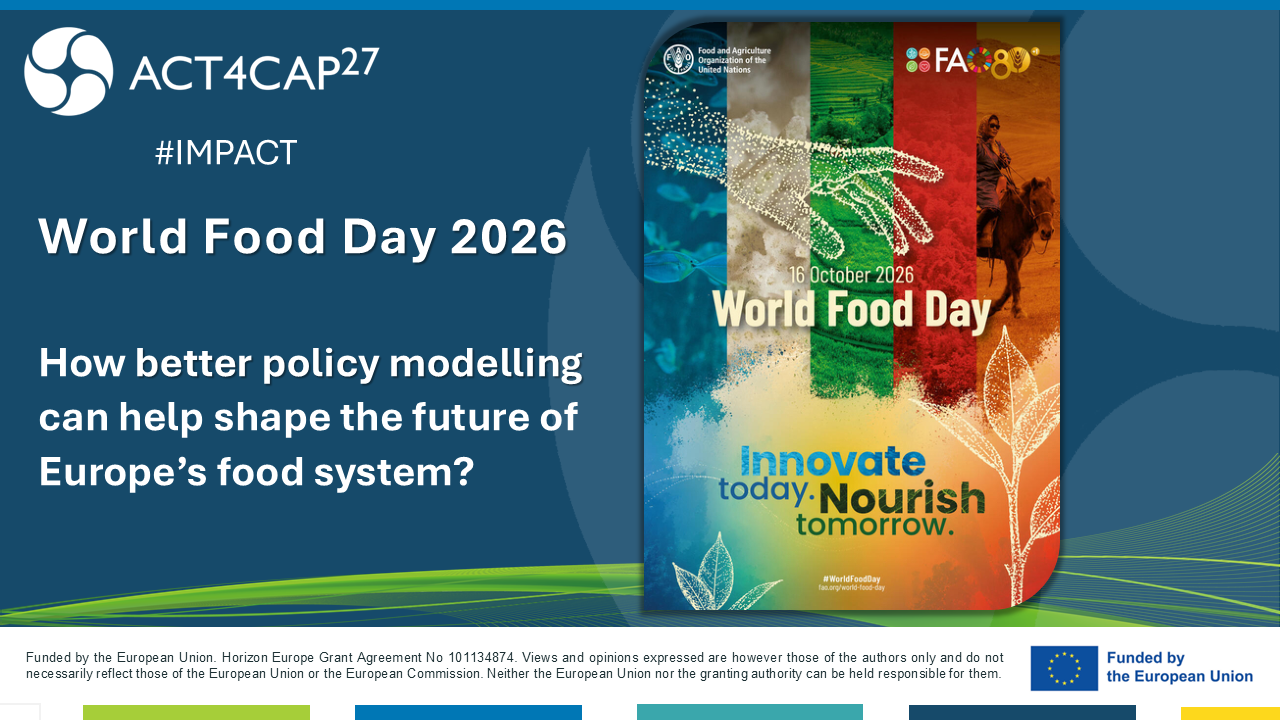
As we highlighted in our World Food Day 2026 article, better policy modelling can help decision-makers compare alternative futures, examine the assumptions behind them and understand where benefits, costs and trade-offs may arise. Stakeholder knowledge is an important part of this process. By bringing scientific analysis into dialogue with policy experience and practical perspectives, we can identify where modelling approaches need further development and how their results can become more useful for policy discussions.
We welcome stakeholders working across agriculture, public health, nutrition, environmental policy, air quality, animal health and agricultural economics to join the discussion. The meeting is particularly relevant to European and national policymakers, farmers’ organisations, public authorities, research institutions, health and environmental organisations, veterinary and livestock-sector representatives, consumer organisations and other experts interested in the future of the CAP.
Your contribution will help us test the relevance of our emerging analytical approaches, identify important evidence needs and shape the next stages of our modelling work. We aim to make the discussion useful both for specialists working with agricultural models and for stakeholders who need to understand what the results could mean for future policy choices.
Join us in Brussels to contribute to the discussion on One Health and the CAP post-2027.
📅 Date: Wednesday, 25 November 2026
🕘 Time: 09:00–12:30 CET
📍 Venue: L42, Rue de la Loi 42, 1040 Brussels, Belgium
🤝 Format: In-person stakeholder meeting, registration is open until 18 November 2026
We look forward to exchanging perspectives and working together to strengthen the evidence available for assessing future European agricultural policy