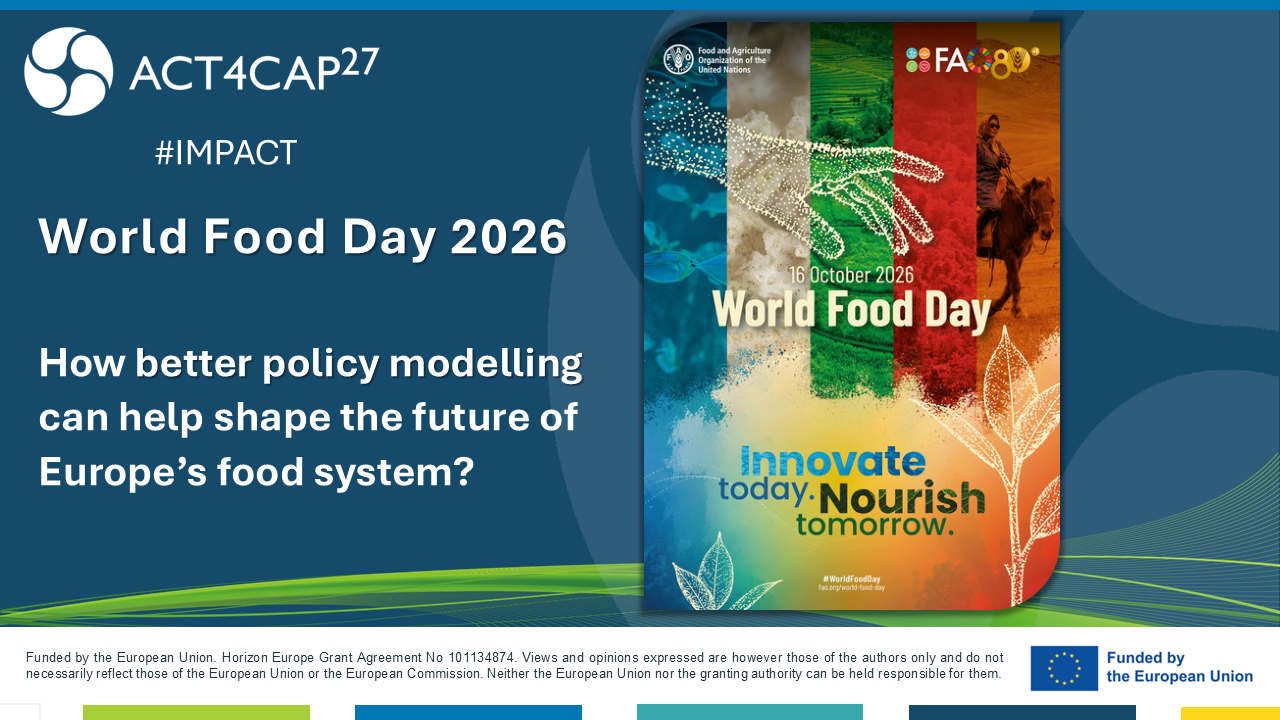
World Food Day 2026 | 16 October 2026
Every day, agricultural policy decisions influence what farmers produce, how food markets function, what consumers can afford and how food production affects the environment. On World Food Day, the Food and Agriculture Organization of the United Nations (FAO) calls attention to the importance of ensuring access to sufficient, safe and nutritious food for everyone. This year’s theme, “Innovate today. Nourish tomorrow.”, highlights how innovation, scientific knowledge and inclusive approaches can help shape the future of agrifood systems.
For Europe, this challenge is closely connected to the future of the Common Agricultural Policy (CAP) and the wider framework of EU agri-food policies after 2027. How can policymakers evaluate different policy choices, anticipate their consequences and understand the trade-offs between economic, social, environmental and climate objectives? These are the questions that the EU-funded ACT4CAP27 project is working to address.
Turning innovation into better-informed policy choices
Innovation in agriculture and food systems encompasses more than new technologies or farming practices. It also includes the analytical tools, data and methods needed to understand how policy decisions affect the food system as a whole.
Agricultural markets, farm incomes, food prices, consumer behaviour, public health and environmental pressures are interconnected. A policy measure intended to address one challenge can have consequences elsewhere in the system. Understanding these relationships is essential when designing policies that remain effective under changing economic, social and environmental conditions.
ACT4CAP27 strengthens the analytical capacity available for evidence-based EU agri-food policymaking after 2027. The project brings together established agricultural and economic models, including CAPRI, GLOBIOM, MAGNET and AGMEMOD, and works to extend their capacity to assess a broader range of food-system impacts.
By developing a common analytical framework, additional assessment modules and an integrated modelling infrastructure, the project aims to help researchers and policymakers examine how different policy options may affect the EU agri-food system.
Assessing the consequences of today’s decisions
The future of European agriculture will be shaped by multiple pressures, from changing market conditions and input costs to climate and environmental challenges and evolving consumer preferences. Policymakers need evidence that helps them understand these pressures together and assess possible responses.
ACT4CAP27 addresses this need through quantitative assessments of EU agri-food policy options after 2027. Its work includes strengthening the representation of environmental effects, health-related aspects, socioeconomic outcomes, production inputs, consumption patterns and changes along food supply chains.
This broader analytical perspective can help identify potential synergies and trade-offs between policy objectives. It can also support comparisons of alternative policy scenarios, making it easier to examine who may benefit, where costs may arise and how outcomes could differ across regions and parts of the food system.
Scenario-based analysis does not predict the future with certainty. Instead, it provides a structured way to explore possible developments, test assumptions and understand the implications of different policy choices before decisions are implemented.
Connecting scientific evidence with policy and practice
Better modelling delivers value when its results can inform real decisions. ACT4CAP27 therefore combines methodological development with collaboration across the agricultural modelling community and engagement with policymakers and other stakeholders.
The project is developing a modular toolbox for EU food-system policy modelling, supported by data and model infrastructure, to facilitate the assessment and exploration of policy scenarios. Its work also aims to strengthen collaboration between modelling teams and improve access to analytical capabilities and results.
This approach can help bring scientific evidence closer to the policy process. By making assumptions, methods and potential outcomes easier to examine, the project supports informed discussion about the choices facing European agriculture and the wider food system.
Innovating today to inform tomorrow’s food policies
World Food Day is a reminder that the future of food depends on the decisions made today. For European agriculture, this means developing the knowledge and analytical capacity to evaluate policy options against a range of interconnected objectives, including food availability and affordability, farmers’ economic prospects, public health and environmental protection.
Through its work on modelling tools, integrated assessments and stakeholder dialogue, ACT4CAP27 contributes to this effort by strengthening the evidence base for future EU agri-food policies.