
This scenario shows that a substantial reduction in sugar consumption could have impacts far beyond sugar itself. By tracing a defined dietary transition through health, food demand, agricultural production, trade and farm income, ACT4CAP27 demonstrates why future food and agricultural policy choices benefit from integrated assessment.
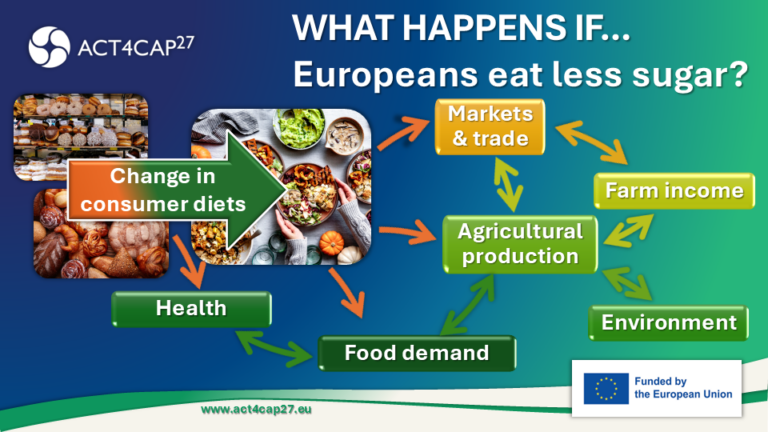
Reducing sugar consumption is often discussed as a public health objective. However, a large-scale dietary transition would also affect the wider food system.
Sugary foods contain more than sugar. They may also contain wheat, dairy products, eggs, fats and other agricultural commodities. If people consume fewer of these foods, demand can change across several agricultural sectors at the same time.
This creates an important policy challenge. A dietary transition could generate substantial health benefits while also creating adjustment pressures for farmers, food producers and agricultural markets. The consequences could differ considerably between Member States, depending on the structure of their agricultural sectors.
Understanding these connections is essential for policies that seek to improve health while supporting a resilient, competitive and sustainable European food system.
What could happen if Europeans substantially reduced their intake of sugary foods to move towards healthier dietary levels?
The scenario examines a dietary transition towards the 30 g per day free-sugar threshold of the EAT–Lancet Planetary Health Diet. The modelled transition is based on reduced intake of sugary foods. It does not assume that the transition is achieved through one specific EU-wide tax instrument. Also, in this stylised scenario, reformulation of sugary foods, i.e., reduced sugar content or substitution through non-nutritive sweeteners is not considered.
ACT4CAP27 investigates the consequences of a substantial reduction in the intake of sugary foods across the food system.
The analysis connects:
The analysis uses Germany as the reference case for the dietary transition and extends the resulting adjustment pattern to other EU Member States for the wider agricultural assessment.
The health assessment considers the effects of the modelled energy reduction through the body-weight pathway. The agricultural assessment captures the wider consequences of reducing consumption of foods containing sugar and their associated ingredients.
The scenario shows that reducing sugar intake can have consequences well beyond sugar itself.
***
A substantial dietary adjustment is required
The analysis starts from an average adult free-sugar intake of approximately 105 g per day in Germany and examines a transition towards the 30 g per day EAT–Lancet target.
The modelled adjustment is non-linear. Some foods are reduced earlier in the transition, while other foods prove more resistant to change.
The adjustment pattern includes reductions in categories such as:
More stringent reductions also affect categories such as dairy desserts and composite dishes, while jam and similar products are among the more resistant categories in the modelled transition.
***
Health benefits can be substantial
Under the full-adoption scenario, the model estimates that weight-attributable deaths in Germany in 2035 could fall from approximately 94,300 in the baseline to 66,200. The reduction in energy intake stems not only from the reduced intake of sugar, but also from the reduced intake of its accompanying ingredients, such as dairy, eggs, wheat and fats.
This corresponds to approximately: 28,153 fewer weight-attributable deaths or around 30% fewer deaths attributable to high body weight compared with the baseline scenario.
Under the half-adoption scenario, approximately: 14,973 fewer deaths are estimated, corresponding to around 16% fewer weight-attributable deaths than in the baseline.
These estimates represent the health effects of the modelled dietary and energy changes through the weight pathway.
***
The effects extend beyond sugar
The modelled dietary transition reduces demand for foods containing sugar and therefore also affects the other ingredients used in those foods.
In the German market analysis, the scenario results indicate substantial reductions in demand for several commodities, including:
The wider agricultural assessment indicates that these co-ingredient effects are important for understanding the consequences of dietary change.
***
Agricultural effects differ between countries and sectors
When the dietary adjustment is extended across the EU and assessed through agricultural market analysis, the consequences differ between Member States.
The results indicate:
The distribution of impacts reflects the structure of national agricultural economies. Countries with greater exposure to dairy and livestock production can face different adjustment effects from countries with stronger exposure to crop production.
***
The results show a link between health benefits and agricultural adjustment
The scenario illustrates that a single dietary transition can produce both: potentially substantial health gains, and significant adjustment effects across agricultural markets and sectors.
The scale of these effects depends on how dietary change occurs.
The analysis therefore provides an upper-bound scenario for a transition achieved exclusively through reduced intake of sugary foods. In real-world conditions, sugar reduction may also occur through product reformulation and substitution by non-nutritive sweeteners. These pathways would alter the resulting effects across food demand, agriculture and health.
A change in food consumption can propagate through several interconnected systems.
CONSUMERS – People change the quantities of the foods they consume.
↓
HEALTH – Changes in energy intake affect body weight and associated health outcomes.
↓
FOOD DEMAND – Reduced intake of sugary foods changes demand for sugar and co-ingredients.
↓
AGRICULTURAL MARKETS – Changes in demand influence production, markets and trade.
↓
FARM INCOMES – The effects are distributed differently across agricultural sectors and Member States.
This chain cannot be fully understood by examining sugar consumption, health or agricultural production separately.
Integrated assessment makes the connections between these dimensions visible and allows policymakers to examine wider consequences alongside the primary policy objective.
The scenario demonstrates the value of connecting different analytical perspectives around one policy-relevant question.
A food-level perspective – The analysis treats the food consumed by people as the starting point of the transition. This captures the consequences of changing demand for the full set of ingredients associated with sugary foods.
A cross-sector perspective – The assessment connects consumption changes with agricultural commodities, production, trade and income. This helps identify consequences that are not visible in an analysis focused only on sugar.
A cross-country perspective – The analysis shows how the same broad dietary transition can have different implications in different Member States because agricultural structures vary.
A health and agriculture perspective – The scenario places potential health gains and agricultural adjustment effects within the same analytical picture.
A policy exploration perspective – The analysis supports the examination of alternative pathways and levels of dietary change. It can therefore help inform discussions about the potential consequences of future policy choices without treating one specific policy instrument as the only route to achieving the dietary outcome.
The scenario does not prescribe one specific policy instrument.
Its value lies in showing the consequences associated with a specified dietary transition and in making the wider effects visible.
Different policy approaches can lead to different pathways of change, including:
The resulting effects on health, food markets and agriculture will therefore depend not only on the dietary transition itself, but also on the pathway through which it is achieved.
This creates a need for policy assessment that considers the full system and the interactions between different responses, rather than focusing on one isolated outcome.
The scenario has potential relevance for several interconnected EU policy areas. Its policy value lies in showing how a change in food consumption can generate consequences across the wider agri-food system and therefore requires consideration across policy domains.
***
Sustainable food systems, food consumption and healthy diets
The scenario is particularly relevant to the European Commission’s Vision for Agriculture and Food, which provides a framework for shaping an agri-food sector that is attractive, competitive, future-proof and fair towards 2040. The Vision also highlights the importance of healthy, quality food, stronger links between citizens and the food they consume, food innovation and consumer awareness.
Potential policy influence:
The analysis can support policy discussions on dietary-change pathways by showing how a specified reduction in sugar consumption may affect health outcomes, food demand, agricultural production and farm income simultaneously. It can therefore contribute evidence to policy assessments in which dietary objectives need to be considered together with the economic and structural consequences for the agri-food system.
The analysis does not assess the impact of one specific EU sugar tax (I would just take it out of the title, then we don’t have to repeat over ang over again, what we are NOT doing). It examines the consequences of a defined dietary transition and can therefore inform consideration of different policy pathways that might contribute to changes in sugar consumption.
***
Food processing, reformulation and the agri-food value chain
The scenario demonstrates that the consequences of reduced sugar consumption depend on how the dietary change occurs. Reduced consumption of sugar-containing foods can affect demand for several co-ingredients and agricultural commodities. Alternative pathways, such as reformulation or substitution, may generate different effects across the food value chain.
Potential policy influence:
The analysis can inform discussions involving food manufacturers, retailers and other value-chain actors by providing evidence on the potential system-wide consequences of different pathways towards lower sugar consumption. It can help policymakers consider how consumer demand, product composition and agricultural markets are connected when assessing future food policy options.
***
Common Agricultural Policy and agricultural adjustment
The scenario is directly relevant to the agricultural consequences of changing food demand. Under Regulation (EU) 2021/2115, CAP Strategic Plans are based on Member State needs assessments, intervention strategies and targets linked to the CAP’s specific objectives.
Potential policy influence:
The analysis can provide evidence for:
The scenario does not prescribe CAP interventions, compensation mechanisms or sectoral support measures. Its contribution is to provide evidence on potential market and income consequences that can be considered alongside other analyses when assessing future agricultural policy choices.
This is also relevant to the Commission’s Vision for Agriculture and Food, which places emphasis on a competitive and resilient agri-food sector, fair incomes and the ability of the sector to adapt to changing economic, societal and geopolitical conditions.
***
Public health, disease prevention and health promotion
The scenario has potential relevance to EU action on health promotion and the prevention of non-communicable diseases. The European Commission identifies cardiovascular diseases, diabetes and cancer among the major non-communicable diseases contributing substantially to the EU disease burden and emphasises the importance of prevention and health promotion.
Potential policy influence:
The health assessment can contribute evidence on the potential population-level consequences of a defined dietary transition. It can support discussions on how changes in food consumption may affect health outcomes and how dietary objectives can be considered within broader prevention strategies.
The scenario does not replace clinical, epidemiological or public-health impact assessments. It provides an integrated estimate of health consequences associated with the specified dietary change.
***
Consumer information and food choice
EU food-information legislation establishes requirements intended to ensure that consumers receive information about the content and composition of food products. Regulation (EU) No 1169/2011 provides the main framework for food information to consumers, including nutrition declarations for most prepacked processed foods.
Potential policy influence:
The scenario can contribute to policy discussions on measures that influence food choice and consumption by placing consumer behaviour within a wider food-system context. It highlights that changes in consumer demand can have consequences for food businesses, agricultural production, commodity markets and farm income.
The scenario does not assess the effectiveness of a particular labelling system or consumer-information instrument.
***
What the result can contribute to future policy decisions
The scenario analysis can support policymakers and other stakeholders in:
The analysis is therefore particularly relevant to policy processes in which an intervention or societal change has an objective in one policy area but consequences across several others. It provides evidence that can help policymakers assess these interdependencies when considering future options for the European agri-food system.
The scenario shows why future policy assessment of dietary change should consider health, consumer behaviour, food markets, agricultural production, trade and farm income together, in line with the European Commission’s objective of developing an attractive, competitive, future-proof and fair agri-food sector towards 2040.
European Commission services
Relevant services can use the evidence to support cross-policy analysis involving food, health, agriculture, markets and sustainability.
Potentially relevant policy areas include:
***
National ministries and public authorities
National authorities can use the results to consider how dietary transitions may affect national agricultural structures, sectors and populations.
***
Agricultural organisations
Farm organisations and sectoral organisations can use the analysis to understand potential exposure to changes in demand for agricultural commodities associated with dietary change.
***
Food manufacturers and retailers
Food-system businesses can use the results to consider the implications of different pathways to sugar reduction, including reduced consumption, reformulation and substitution.
***
Public health and civil society organisations
These organisations can use the analysis to examine the wider implications of dietary transitions and to connect health objectives with food-system and agricultural consequences.
***
Researchers and analysts
The scenario provides an integrated analytical basis for further research into dietary change, agricultural markets, health and policy design.
The scenario analysis can be used as:
Evidence for policy impact assessment – The results can inform assessments of policies or strategies that could influence food consumption and dietary patterns.
A basis for scenario comparison – Alternative dietary-transition pathways can be compared according to their consequences for health, food demand and agricultural markets.
A screening tool for cross-sector effects – The results can help identify where a policy objective may create significant consequences outside its primary policy area.
A basis for stakeholder dialogue – The analysis can provide a common evidence base for discussions between public authorities, farmers, food businesses, public-health stakeholders and civil society.
A starting point for further modelling – The scenario can support future analyses with more detailed policy instruments, country-specific behavioural responses or alternative transition pathways.
The scenario demonstrates how ACT4CAP27 can connect policy questions that are often assessed separately.
Future applications could extend the analysis by examining:
Such extensions could help policymakers move from a broad scenario question to a more specific assessment of alternative policy designs.
A healthier diet can reshape the entire food system.
ACT4CAP27 shows that reducing sugar consumption is not only a question of changing what people eat. It can also affect health outcomes, demand for agricultural commodities, production, trade and farm incomes. Integrated assessment makes these connections visible and provides evidence for considering the wider consequences of future food and agricultural policy choices.
This scenario shows that a substantial reduction in sugar consumption could have consequences far beyond sugar itself. By tracing a defined dietary transition through health, food demand, agricultural production, trade and farm income, ACT4CAP27 demonstrates why future food and agricultural policy choices benefit from integrated assessment.
The analysis examines what could happen if average adult sugar consumption were reduced towards the 30 g/day reference level used in the scenario. The dietary change is then followed through its potential consequences for food demand, agricultural markets, trade, farm income and health.
Sugar is usually consumed as part of foods such as beverages, confectionery, bakery products, desserts and other processed products. These foods also contain other ingredients, including cereals, dairy products, eggs and fats.
When consumption of the food changes, demand for these co-ingredients may also change. Analysing foods therefore helps capture consequences that a sugar-only analysis would miss.
The wider analysis recognises three possible routes to lower sugar intake:
The scenario only covers reduced consumption of sugary foods. This provides a defined pathway for assessing the potential consequences of dietary change, but it does not represent every possible real-world transition.
Because the analysis assumes that the dietary target is achieved through reduced consumption of sugary foods, without allowing reformulation or substitution to absorb part of the reduction.
In a real-world transition, these pathways could occur together. The effects on agricultural demand and income could therefore be smaller than in this scenario.
The health assessment estimates the consequences of the modelled change in energy intake through the energy–body-weight pathway. The resulting change in the distribution of high body weight is then linked to attributable mortality using a comparative risk assessment framework.
The reported health effects should therefore be understood as weight-attributable effects associated with the modelled dietary transition.
No. Because the scenario reduces the intake of sugar-containing foods, the associated reduction in energy intake also includes calories from other ingredients in these foods.
The analysis therefore examines how the health effect may be associated with the different calorie sources removed through the dietary transition. This is an important consequence of analysing foods rather than sugar as an isolated ingredient.
For Germany, there exists a dataset linking foods and their average intake quantities to recipes and the market level needed to construct the dietary transition. The resulting adjustment pathway is then transferred to other EU Member States using country-specific food consumption structures and market information.
The transfer is an analytical assumption and an important limitation: actual dietary responses could differ between countries because of differences in food culture, product availability and price responsiveness.
No. The scenario represents a structured modelling exercise based on observed consumption patterns and assumptions about how consumers adjust their diets.
It is designed to explore the consequences of a defined transition, not to predict the behaviour of every individual consumer.
They are scenario results, not forecasts. They answer the question: What could happen under the specified assumptions?
The results should therefore be used to explore possible consequences, trade-offs and distributional effects rather than as a prediction of one inevitable future.
The main policy relevance is that a change in food consumption can have consequences across several policy areas at the same time.
A dietary transition may affect:
This supports more integrated assessment of future food and agricultural policy choices.
Yes. The scenario is relevant to the Commission’s Vision for Agriculture and Food, particularly its focus on a competitive, resilient, future-proof and fair agri-food sector towards 2040.
The analysis contributes evidence on how changing societal and consumer demand could affect agricultural markets, food value chains and farm income, while also considering health outcomes.
It can contribute evidence to future agricultural policy assessment, but it does not prescribe CAP measures.
The results can help identify:
These findings can be considered alongside other evidence in future policy assessments and CAP-related discussions.
The scenario indicates that the consequences extend beyond sugar production. Depending on the food products affected, changes in demand can also influence sectors linked to co-ingredients such as dairy, eggs, cereals and fats.
The precise distribution of impacts depends on the structure of each Member State’s agricultural sector.
No. Agricultural structures differ considerably across the EU.
The same dietary transition can therefore produce different consequences depending on the importance of different commodities and sectors in national agricultural economies.
If there is no increased intake of other foods, it is just a demand increase, prices drop and farmers don’t get anything positive out of it.
It shows that a dietary transition can create adjustment and distributional effects for some agricultural sectors and Member States.
Whether the overall policy outcome is desirable depends on the objectives being considered, including health benefits, fiscal effects, environmental consequences and the costs and opportunities associated with agricultural adjustment.
A policy objective in one part of the food system can create consequences elsewhere.
Health-oriented dietary change can affect agricultural markets. Agricultural adjustment can affect different Member States differently. These interactions should be visible when future policy options are assessed.
Because changes in food consumption can influence demand for agricultural commodities and therefore affect different sectors in different ways.
The scenario can help stakeholders understand where potential exposure to changing demand may arise and support discussions about adjustment and resilience.
A strong use of the two strategies not considered in the scenario, i.e., reducing sugar content of foods and substitution through non-nutritive sweeteners, can reduce changes in demand for non-sugar ingredients and thus decrease market-changes.
The scenario highlights the importance of the pathway through which sugar consumption is reduced.
Reduced consumption, reformulation and ingredient substitution can have different consequences for food products, ingredient demand and agricultural markets. This makes the scenario relevant to discussions about product development and future food-market trends.
The analysis provides an integrated perspective on the potential health consequences of a defined dietary transition and connects those effects to wider food-system impacts.
It can therefore contribute to discussions on prevention and dietary change while highlighting the importance of considering wider economic and agricultural consequences.
Because the analysis helps make cross-sectoral consequences visible.
A policy measure or societal transition may be designed to achieve one objective but affect consumers, producers, markets, trade and health simultaneously. Integrated assessment can help identify these effects before policy choices are made.
The scenario is primarily an analytical exercise. Stakeholders can contribute to its interpretation, validation and uptake by bringing knowledge of consumer behaviour, agricultural structures, food markets and policy implementation.
This scenario was discussed at the following stakeholder events:
https://act4cap27.eu/1st-stakeholder-meeting-of-the-act4cap27-project-23-october-2024-brussels-be/
https://act4cap27.eu/act4cap27-stakeholder-workshop-april-2026/
This scenario work is still ongoing.
The scenario analysis may provide a basis for:
Potentially, yes. The analytical approach has exploitation relevance because it demonstrates how a defined dietary transition can be connected to multiple dimensions of the agri-food system. Its future value could lie in supporting integrated assessments of food-policy options and their consequences for agriculture, health and markets.
Potential users include:
A real policy assessment would require additional information, including:
The current scenario provides evidence for exploring consequences, not a complete impact assessment of a specific policy proposal.