
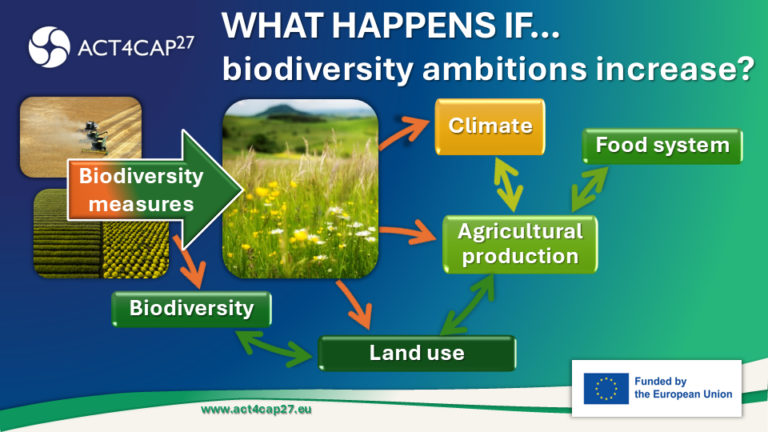
The biodiversity scenario asks what could happen if biodiversity protection and agricultural restoration became more ambitious.
ACT4CAP27 looks at the wider consequences, including biodiversity, land use, agricultural production, food availability, producer prices and greenhouse gas emissions.
The main insight is that these outcomes are connected, but different policy instruments affect them differently.
Biodiversity measures can support ecological recovery without creating a major aggregate production shock, but they do not automatically deliver deep agricultural GHG reductions.
Stronger climate outcomes require explicit mitigation incentives.
The value of the integrated assessment is that it makes these trade-offs and interactions visible, helping policymakers and stakeholders discuss policy choices with a broader evidence base.
Biodiversity loss is increasingly connected to agricultural policy, land use and the resilience of food systems. European policy is moving towards stronger protection and restoration of nature. The EU Biodiversity Strategy for 2030 includes a target to protect 30% of EU land and sea areas, while the Nature Restoration Regulation establishes a framework for restoration measures covering, as an EU target, at least 20% of land and sea areas by 2030.
For agriculture, the policy challenge is complex. Biodiversity measures can improve habitats, landscape diversity and ecosystem resilience, but they may also affect how land is managed and how agricultural production develops. Their consequences can therefore extend beyond biodiversity itself, influencing production, food availability, markets, land use and potentially the wider economic conditions of farming.
The ACT4CAP27 biodiversity fast-track scenario explores these interconnections. It asks what could happen when biodiversity protection and agricultural restoration become more ambitious, and how these effects interact with other major policy choices affecting European agriculture.
What could happen if the EU significantly strengthened biodiversity protection and restoration measures affecting agricultural land?
The scenario examines an ambitious biodiversity pathway in which 30% of EU terrestrial land is protected and 20% of agricultural land is managed through biodiversity-friendly restoration practices by 2030. The agricultural measures considered include organic farming, agroforestry, fallow land, landscape elements, buffer strips, hedgerows, field margins and other low-intensity or biodiversity-friendly management practices.
These assumptions represent a scenario for exploring policy consequences. They are not a projection of future policy decisions.
The scenario assesses how stronger biodiversity-oriented land management may interact with the wider agricultural and food system.
The analysis considers:
The analysis also compares the biodiversity pathway with scenarios based on direct agricultural greenhouse gas mitigation, technology adoption, and combinations of these approaches.
This makes it possible to examine whether biodiversity and climate policies reinforce each other, produce limited additional effects, or create new trade-offs for production and food-system outcomes.
Biodiversity measures can improve ecological outcomes without creating a major aggregate production shock
The biodiversity scenario produces limited changes in aggregate EU agricultural production, producer prices and calorie availability compared with the baseline across the models considered. The results indicate that ambitious biodiversity-oriented land management does not necessarily translate into a large production shock at EU level.
***
Biodiversity policy alone is not a substitute for agricultural climate mitigation
The scenario produces only limited reductions in agricultural greenhouse gas emissions. The analysis indicates that biodiversity-oriented land management, protection and restoration do not automatically deliver deep reductions in farm-gate agricultural emissions.
***
Biodiversity gains are strongly connected to land-use pressure
The biodiversity intactness response is linked to changes in cropland and grassland pressure. The analysis indicates that reducing pressure on agricultural land can create stronger conditions for biodiversity recovery, particularly where lower agricultural demand is combined with conservation and restoration measures.
***
Climate-policy choices can influence biodiversity outcomes
The analysis indicates that the strongest biodiversity gains occur in scenarios where agricultural production and land-use pressures are reduced. In this sense, climate and biodiversity outcomes can be connected through changes in production systems, livestock demand and land use.
***
Policy packages need to be assessed as integrated systems
The results show that combining policy instruments does not automatically produce additive benefits. The effects of biodiversity measures depend on how they interact with production, land demand, climate policy and land management.
Biodiversity policy is implemented within a food system that is connected through land, markets, production and consumption.
A biodiversity measure may:
change land management → influence production decisions → affect land demand → alter market conditions → influence environmental outcomes elsewhere.
The direction and magnitude of these effects depend on the policy package and the wider socioeconomic context.
ACT4CAP27 brings these interactions into a common analytical perspective. By connecting economic, environmental, climate and land-use dimensions, the scenario analysis helps stakeholders examine the wider consequences of policy choices and the trade-offs or synergies that may not be visible when each objective is assessed separately.
The value of the scenario lies in its integrated assessment of policy consequences across multiple dimensions of European agriculture and food systems.
The analysis provides a structured basis for comparing:
This helps identify which outcomes are primarily driven by biodiversity measures, which are driven by climate-policy instruments, and where interactions between policy objectives become important.
The results are therefore relevant for policy discussions in which biodiversity, climate mitigation, agricultural production and food-system resilience need to be considered together.
The analysis does not identify a single policy instrument that maximises all outcomes simultaneously.
The results point towards different policy profiles:
For policymakers, this highlights the importance of assessing biodiversity measures together with the wider agricultural, climate and food-system policy context.
The ACT4CAP27 biodiversity scenario has potential relevance for European policy areas where biodiversity protection, ecosystem restoration, agricultural land management, climate policy and food-system outcomes intersect.
ACT4CAP27 helps policymakers assess biodiversity policy as part of a connected agricultural and food system, making visible the environmental benefits, economic implications and interactions with climate and land-use policy.
***
Common Agricultural Policy (CAP)
Potential influence: The analysis can support reflection on how CAP instruments and agricultural land-management measures may contribute to biodiversity objectives while affecting production, land use, prices and food availability.
The results can inform the design and assessment of combinations of agri-environmental measures, biodiversity-oriented land management and other policy instruments within the broader CAP policy framework.
The relevance is particularly strong where policy decisions need to assess environmental ambition alongside possible effects on agricultural production and farm-sector adjustment.
***
EU Biodiversity Strategy for 2030
Potential influence: The scenario provides an analytical framework for examining the wider agricultural and food-system implications of biodiversity protection and restoration ambitions.
The European Commission describes the Biodiversity Strategy for 2030 as an EU plan to put biodiversity on a path to recovery by 2030, including commitments to protect nature and reverse ecosystem degradation.
ACT4CAP27 contributes by examining how biodiversity-oriented land management may interact with agricultural production, land pressure and other policy objectives.
***
Nature Restoration Regulation
Potential influence: The scenario can support policy analysis of the agricultural and food-system context surrounding restoration ambitions.
Regulation (EU) 2024/1991 establishes a framework for restoration measures with an EU objective covering at least 20% of land and sea areas by 2030 and all ecosystems in need of restoration by 2050. The Regulation also explicitly connects ecosystem restoration with climate objectives and food security.
This is directly relevant to integrated assessment because the Regulation itself recognises links between biodiversity recovery, climate objectives and food security. ACT4CAP27 can contribute evidence on how biodiversity-oriented measures may interact with agricultural production and land-use dynamics.
***
EU climate policy and agricultural GHG mitigation
Potential influence: The scenario comparison can support assessment of how biodiversity measures interact with alternative approaches to reducing agricultural greenhouse gas emissions.
The analysis indicates that biodiversity measures alone produce limited direct reductions in agricultural GHG emissions, while the strongest mitigation effects arise from explicit climate-policy instruments. This supports the policy relevance of considering biodiversity and agricultural climate mitigation as complementary but distinct policy objectives.
***
Food security and food-system resilience
Potential influence: The scenario provides evidence for assessing whether biodiversity-oriented measures generate substantial changes in aggregate agricultural production and calorie availability under the scenario assumptions.
This can support future policy assessments where environmental ambition needs to be considered together with food availability, production capacity and land-use pressures.
The scenario analysis can support:
The scenario analysis can be used as:
Its value increases when the scenario results are used together with stakeholder knowledge and more detailed assessments of regional, sectoral and distributional effects.
The biodiversity scenario demonstrates how ACT4CAP27 can transform a broad policy question into a structured assessment of multiple interconnected consequences.
The approach supports a policy cycle in which:
policy ambition is defined → alternative pathways are explored → cross-sectoral effects are assessed → trade-offs and synergies become visible → stakeholders can discuss implications → evidence supports better-informed policy choices.
The result can therefore serve as a foundation for future exploitation through policy analysis, scenario exploration, stakeholder engagement, capacity building and further development of integrated agricultural modelling and assessment tools.
Biodiversity policy can improve ecological outcomes, but its wider consequences depend on how it interacts with agricultural production, land-use pressure, climate policy and food-system dynamics. Integrated assessment helps make these interactions visible before policy choices are implemented.
It explores what could happen if biodiversity protection and agricultural restoration become more ambitious across the EU.
The scenario assumes that 30% of EU terrestrial land is protected and that 20% of agricultural land is managed through biodiversity-friendly restoration practices by 2030. The agricultural measures considered include organic farming, agroforestry, fallow land, landscape elements, buffer strips, hedgerows, field margins and other low-intensity or biodiversity-friendly management practices.
These assumptions are used as a scenario for exploring possible consequences. They should not be interpreted as a forecast of future policy decisions.
Because biodiversity protection and ecosystem restoration are increasingly important parts of European environmental and agricultural policy, while their wider implications for agriculture and food systems need to be understood.
The scenario is linked to the broader European biodiversity and nature-restoration policy agenda. The analysis examines how stronger biodiversity-oriented land management may interact with agricultural production, land use, climate mitigation and food-system outcomes.
What could happen if biodiversity protection and agricultural restoration become significantly more ambitious?
The scenario asks what the wider consequences might be across biodiversity, land use, agricultural production, greenhouse gas emissions, producer prices and calorie availability.
No. This is a structured exploration of a possible policy pathway, not a forecast.
It is a scenario analysis designed to explore the possible implications of a specified policy pathway under common baseline assumptions.
The results show how the agricultural and food system may respond under the scenario assumptions. They do not predict that the policy measures will necessarily be implemented in exactly this form.
The scenario assesses the effects of biodiversity-oriented policy measures on:
The analysis also compares biodiversity measures with direct GHG mitigation, technology adoption, and combinations of these approaches.
The main finding is that biodiversity policy and agricultural climate policy do not produce the same effects.
The analysis indicates that:
The scenario results indicate limited effects on aggregate EU agricultural production.
Across the models considered, biodiversity and technology-adoption scenarios show relatively limited changes in aggregate agricultural production compared with the baseline.
The scenario analysis therefore does not indicate a major aggregate production shock under the biodiversity scenario assumptions.
Important:
This is an aggregate EU-level result. It should not be interpreted as meaning that individual sectors, regions, farm types or production systems would experience no effects.
The scenario shows limited changes in aggregate calorie availability under the biodiversity scenario.
The effects are more pronounced under the direct mitigation scenarios, where agricultural GHG pricing leads to larger adjustments in production and food-system outcomes.
The biodiversity scenario itself produces limited changes in aggregate calorie availability in the model results. The wider effects depend on the policy package and the interactions with production and land use.
Not by itself.
The scenario analysis indicates that biodiversity measures alone deliver limited direct reductions in farm-gate agricultural GHG emissions.
This is an important result because it shows that:
Biodiversity policy should not automatically be treated as a substitute for dedicated agricultural climate-mitigation policy.
The strongest reductions arise in scenarios with explicit mitigation incentives, either through direct GHG pricing or technology adoption support.
The scenario is primarily designed around protection and restoration of biodiversity, not direct pricing or targeted abatement of agricultural GHG emissions.
The measures may affect land use and agricultural management, but the scenario analysis indicates that these changes do not automatically produce deep reductions in farm-gate methane and nitrous oxide emissions.
The scenario increases biodiversity intactness, but the aggregate effect is relatively modest.
The analysis indicates that biodiversity outcomes are strongly related to agricultural land-use pressure.
Greater biodiversity gains occur where agricultural pressure on cropland and grassland is reduced and conservation or restoration measures are combined with these changes.
Land-use pressure is a key connection between agricultural production and biodiversity outcomes.
Where agricultural demand for land is reduced, the opportunity cost of conservation and restoration can decline. This creates more favourable conditions for biodiversity recovery.
This is one of the central insights of the scenario:
Biodiversity outcomes depend not only on the existence of restoration measures, but also on the wider pressure that agriculture places on land.
Because policymakers often need to consider several objectives simultaneously.
The scenario comparison makes it possible to examine whether:
The analysis shows that the different policy instruments produce different outcome profiles.
No.
The results indicate that combined scenarios do not automatically produce additive benefits.
Adding biodiversity measures to technology adoption or GHG mitigation does not substantially change the main climate-policy-driven emission pathway.
Similarly, biodiversity and land-use responses largely follow the production and land-pressure effects associated with the dominant climate-policy component.
Key message
Policy integration can create opportunities for synergies, but synergies need to be assessed rather than assumed.
There is no single scenario that maximises all outcomes simultaneously.
The scenario comparison shows different trade-offs:
The analysis therefore supports the idea of policy portfolios rather than a single universal instrument.
The scenario analysis uses results from:
The models have different structures and assumptions concerning agricultural production, economic interactions and land-use dynamics.
Because no single model captures all aspects of a complex agricultural and food system.
Using several models makes it possible to examine whether the main conclusions are robust across different analytical structures.
The results vary in magnitude between models, but the qualitative ordering of the main scenario effects is consistent:
Biodiversity measures have the smallest direct mitigation effect; technology adoption provides an intermediate, lower-trade-off pathway; and carbon pricing produces the strongest emission reductions but also the largest production and price responses.
The common baseline is SSP2, a middle-of-the-road socioeconomic pathway. We aligned our baseline also to the EU agricultural outlooks (e.g. GDP, POP) etc.
It provides a shared reference point across CAPRI, MAGNET and GLOBIOM.
The scenario outcomes are assessed as changes relative to the 2050 SSP2 baseline, allowing the analysis to focus on the effects of the policy scenarios rather than differences in underlying socioeconomic assumptions.
A common baseline improves comparability across the scenarios and models.
It allows the analysis to ask:
What changes when the policy assumptions change, while the underlying socioeconomic reference pathway remains harmonised?
The aggregate EU-level results provide the broad system picture. More detailed regional and distributional analysis would require additional assessment and should not be inferred directly from the headline results.
The scenario does not provide a complete farm-level impact assessment.
It does, however, show that policy choices can influence:
The implications for specific farm types and regions require more detailed analysis.
The scenario does not provide a complete farm-level impact assessment.
It does, however, show that policy choices can influence:
The implications for specific farm types and regions require more detailed analysis.
No.
The scenario explores the consequences of a specified biodiversity policy pathway.
Its purpose is to provide evidence for informed discussion of possible policy choices and their wider consequences.
The project provides analytical evidence, not a political decision.
The results can inform discussions about:
Policy decisions remain the responsibility of the relevant institutions and democratic processes.
A central implication is:
Biodiversity policy should be assessed together with agricultural production, land use, climate policy and food-system outcomes.
The analysis indicates that biodiversity measures can deliver ecological benefits, but that their effects on agricultural GHG emissions and other food-system outcomes differ from those of dedicated climate-policy instruments.
The scenario is relevant to the policy questions addressed by these EU policy frameworks.
It explores the implications of stronger protection and restoration ambitions and examines how these may interact with agriculture and food systems.
The scenario should not be described as an assessment of legal compliance with EU legislation or as an evaluation of whether specific Member States will meet legal targets.
The scenario can support:
The biodiversity scenario itself is based on integrated modelling and scenario analysis.
The wider ACT4CAP27 approach also places emphasis on stakeholder engagement and the connection of scientific evidence with policy and stakeholder perspectives.
The scenario provides an analytical basis for stakeholder discussion. Stakeholder perspectives are important for interpreting the relevance, feasibility and implications of alternative policy pathways.
Farmers and farm organisations can contribute practical knowledge about:
This knowledge can help interpret model results and identify questions requiring further analysis.
Because the scenario examines how biodiversity outcomes are connected to:
It provides a basis for discussing whether different policy instruments reinforce or limit each other’s environmental objectives.
Because the scenario examines how environmental policy choices may interact with:
The results can help frame discussions about the wider implications of biodiversity policy for agricultural systems.
The scenario can provide a basis for:
The wider ACT4CAP27 project is developing future analytical and decision-support resources that will extend access to evidence and scenario analysis.
The scenario analysis is an evidence base for policy exploration.
It should not be presented as a standalone operational policy tool unless the specific resource being demonstrated has been formally developed and released for that purpose.
The biodiversity scenario should be presented as a scenario-based analytical result.
Its future exploitation potential may include use in:
The final exploitation status will be determined through the project’s exploitation governance and validation processes.