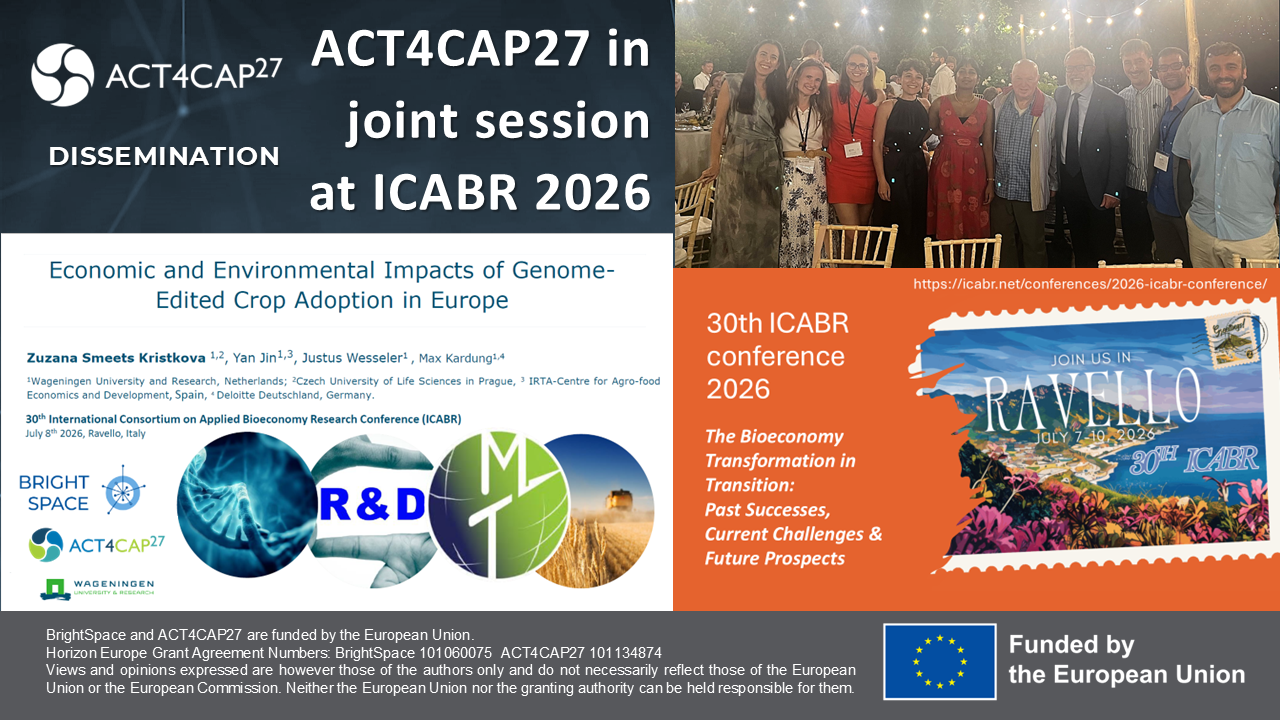
ACT4CAP27 contributed to a joint Horizon Europe session at the 30th International Consortium on Applied Bioeconomy Research (ICABR) Conference in Ravello, Italy, highlighting how advanced modelling approaches can help policymakers assess the impacts of future agricultural innovation and regulatory pathways.
The session, Developing a Generalized Framework for Regulatory Scenario Identification and Applying Real Options Methodology in Innovation Policy, brought together researchers from ACT4CAP27, BrightSpace, RATION, DETECTIVE and GeneBEcon to examine how regulatory uncertainty influences investment decisions, technology adoption and long-term sustainability outcomes.
ACT4CAP27’s contribution focused on the role of integrated economic modelling in understanding how innovations and policy choices affect agricultural systems. Using the MAGNET computable general equilibrium model, the research demonstrated how technology adoption scenarios can be analysed across economic, environmental and trade dimensions, providing insights into potential impacts on productivity, resource use, food markets and competitiveness.
The session illustrated the value of connecting complementary analytical approaches. While Real Options modelling captures how regulatory conditions influence investment incentives and timing, economy-wide models such as MAGNET provide insights into wider market effects and system-level consequences. Together, these approaches strengthen the evidence base available for designing effective policies.
The contributions from the participating Horizon Europe projects demonstrated the importance of collaboration in developing next-generation analytical tools. RATION explored regulatory pathways for low-risk pesticides, DETECTIVE examined investment decisions in NGT-related supply chains, and GeneBEcon contributed perspectives on innovation economics and biotechnology adoption. Combined, these insights provide a broader understanding of how policy frameworks can enable sustainable innovation while managing uncertainty.
Through its work on analytical frameworks, modelling tools and stakeholder-oriented resources, ACT4CAP27 continues to support evidence-informed decisions for the future of the Common Agricultural Policy and European food systems.
Source: WSER, WU