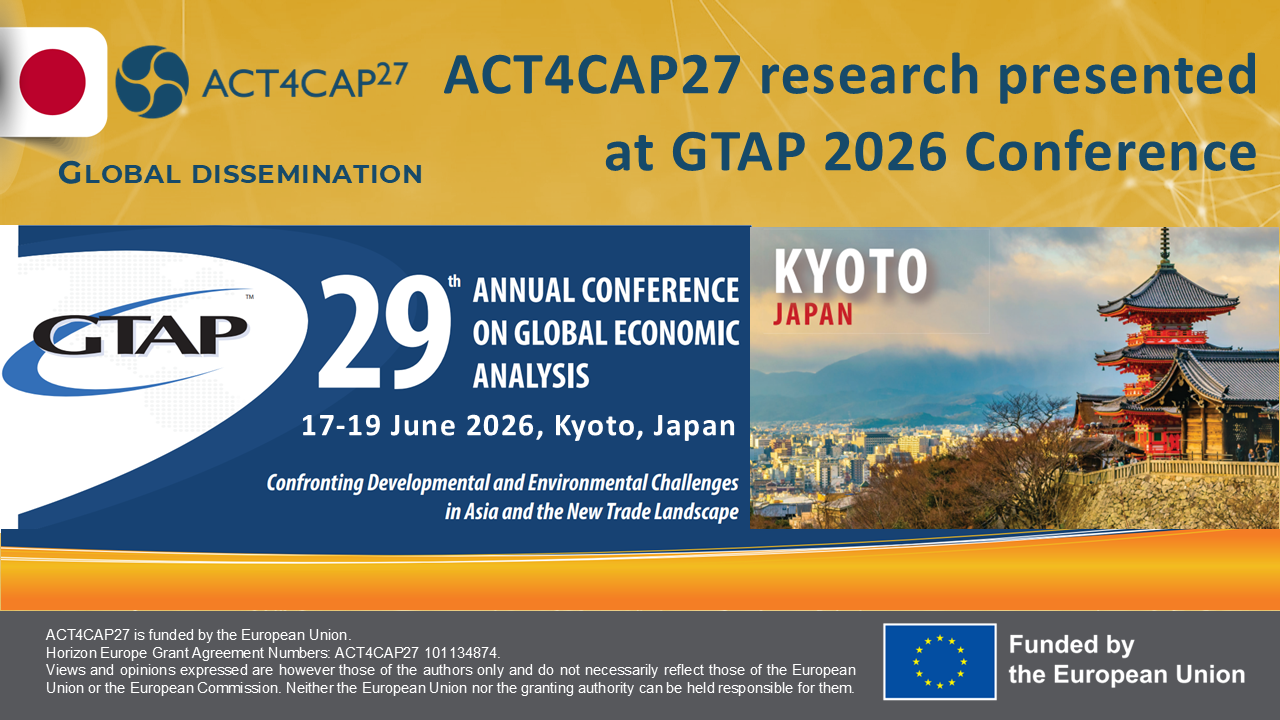
ACT4CAP27 research was presented at the 29th Annual Conference on Global Economic Analysis (GTAP 2026), held in Kyoto, Japan, from 17–19 June 2026. The annual GTAP conference brings together leading researchers working on quantitative analysis of global economic challenges and provides an important forum for exchanging advances in applied economic modelling relevant to agriculture, trade, climate and sustainability.
Omid Zamani (IIASA) presented the paper “Pathways to ‘High-Performance Sustainability’: Does Organic Farming Close or Widen the Gap?”, showcasing research that advances the evidence base for designing sustainable agricultural policies.
The study explores whether expanding organic farming alone is sufficient to achieve the European Union’s sustainability ambitions, or whether complementary policy measures are needed to avoid unintended trade-offs. Using the GLOBIOM model, the research evaluates different policy pathways that combine organic farming targets with agricultural mitigation technologies and integrated policy packages. This enables a systematic assessment of how different policy portfolios influence environmental performance, agricultural productivity and broader sustainability outcomes.
The findings demonstrate that organic farming should be considered as part of a broader policy portfolio rather than a standalone solution. Combining organic production with complementary mitigation measures can help improve environmental performance while reducing trade-offs between climate objectives, biodiversity and agricultural production.
The research contributes to ACT4CAP27’s mission to strengthen the analytical capacity available for evaluating future agricultural policies. By advancing integrated modelling approaches and exploring alternative policy pathways, the project supports the development of robust evidence for the design of the Common Agricultural Policy beyond 2027 and other policies addressing the sustainability transition of European agriculture.
Source: IIASA