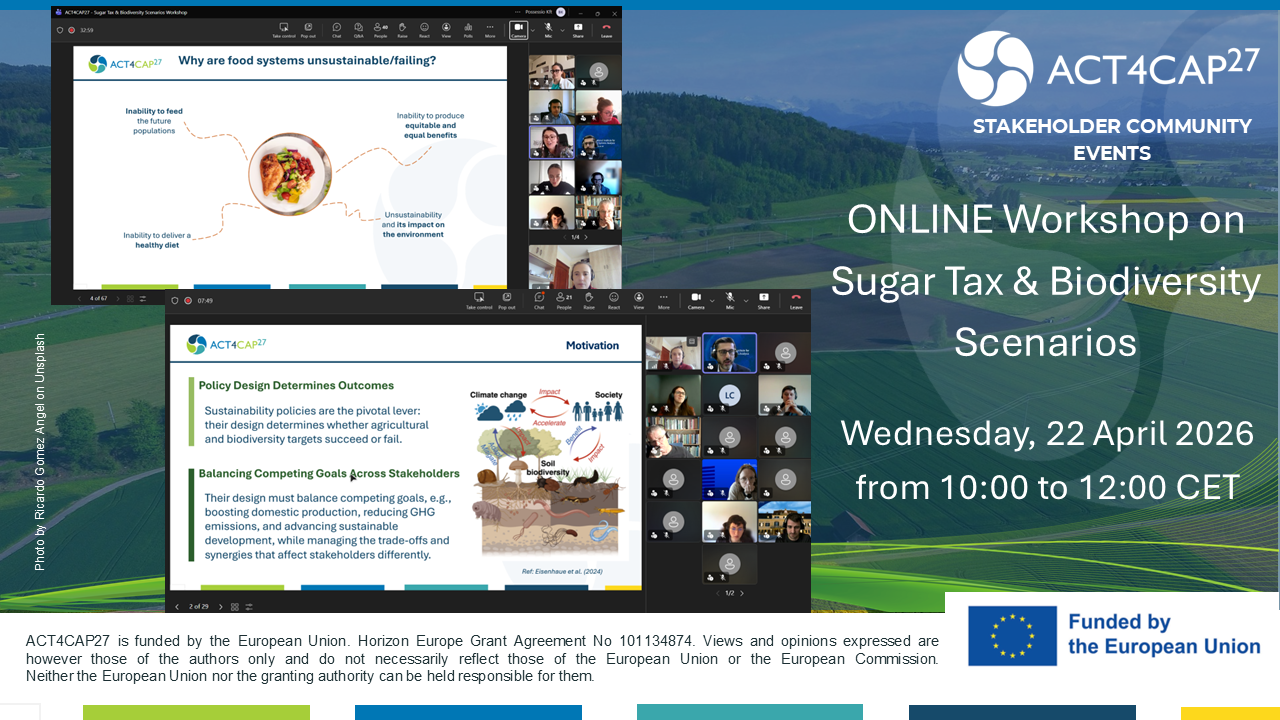
The ACT4CAP27 project successfully held an online stakeholder workshop on 22 April 2026, bringing together experts and representatives from policy, research, industry, and civil society to discuss two key fast-track scenarios: Sugar Reduction and Biodiversity.
The workshop forms part of ACT4CAP27’s ongoing stakeholder engagement strategy, aimed at strengthening the robustness and policy relevance of its modelling framework through direct input from practitioners and decision-makers.
Strengthening modelling through stakeholder insight
The session opened with an overview of the ACT4CAP27 project and its ambition to advance analytical capacity and modelling tools to support evidence-based EU agri-food policies post-2027. A central message was the importance of understanding trade-offs and synergies across economic, social, environmental, and climate objectives within food systems.
Participants were invited to reflect on how well current modelling assumptions capture real-world dynamics, and where refinements are needed.
Parallel discussions on key policy challenges
The workshop continued with two parallel sessions:
Sugar Reduction Scenario – Discussions focused on the impacts of measures on sugar consumption and EU agricultural production. Stakeholders highlighted the importance of accurately representing substitution possibilities in food reformulation, as well as the implications for consumer behaviour and sugar beet producers. Key considerations included technical and economic feasibility of alternatives, supply constraints, and distributional impacts across the value chain.
Biodiversity Scenario – This session explored the trade-offs between biodiversity-enhancing measures and agricultural production. Participants discussed short- versus long-term impacts, the acceptability of potential production losses, and the role of compensation mechanisms. Options such as carbon revenue recycling and market-based instruments were considered as possible tools to support biodiversity-positive practices.
Key takeaways
Across both sessions, a common theme emerged:
robust and policy-relevant modelling depends on integrating stakeholder knowledge and experience.
Participants provided valuable insights into behavioural responses, market dynamics, and implementation constraints, all of which are critical for refining scenario assumptions and improving the accuracy of model outputs.
Next steps
The ACT4CAP27 team will now:
- Review and refine scenario assumptions based on stakeholder feedback
- Integrate insights into the project’s modelling framework
- Feed results into the development of the ACT4CAP27 Interactive Roadmap
- Share a post-workshop summary with participants
These steps will contribute to strengthening the evidence base for future EU agri-food policies and ensuring that modelling outputs are closely aligned with real-world conditions.
Acknowledgements
We extend our sincere thanks to all participants for their active engagement and valuable contributions. Their input plays a crucial role in shaping more effective, inclusive, and forward-looking policy analysis. Participants were also invited to our next stakeholder online seminar in autumn 2026.