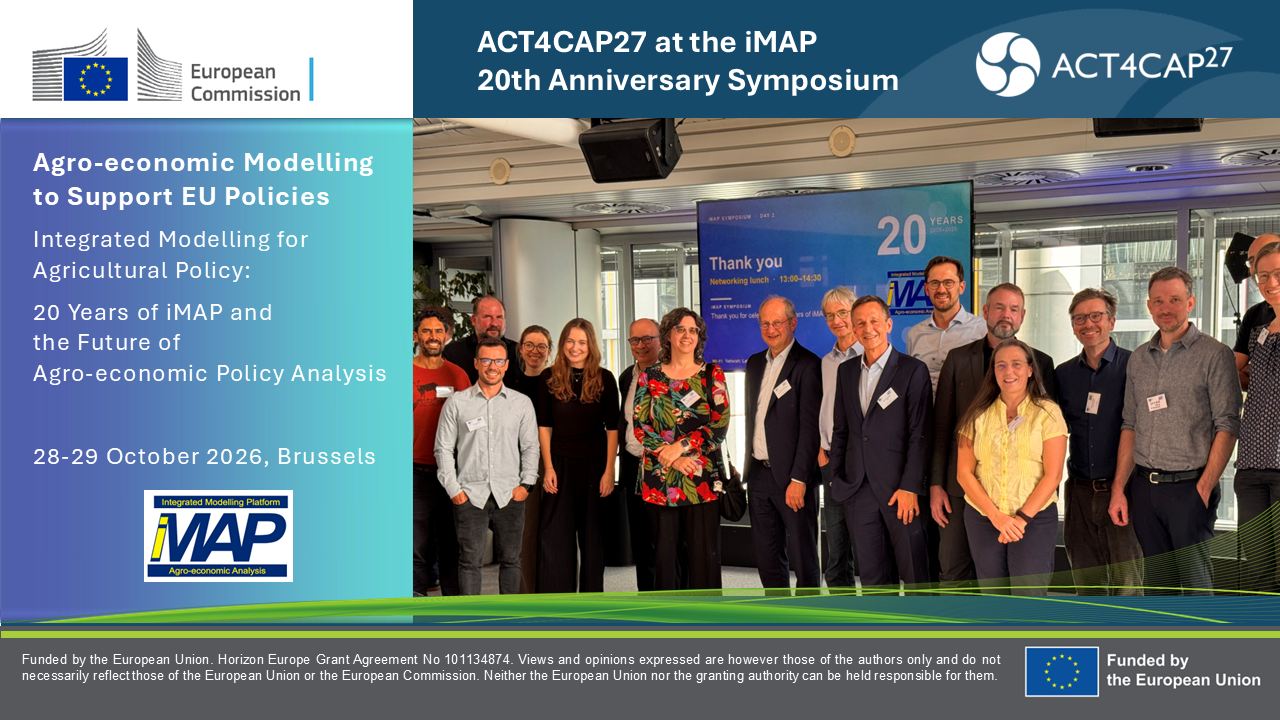
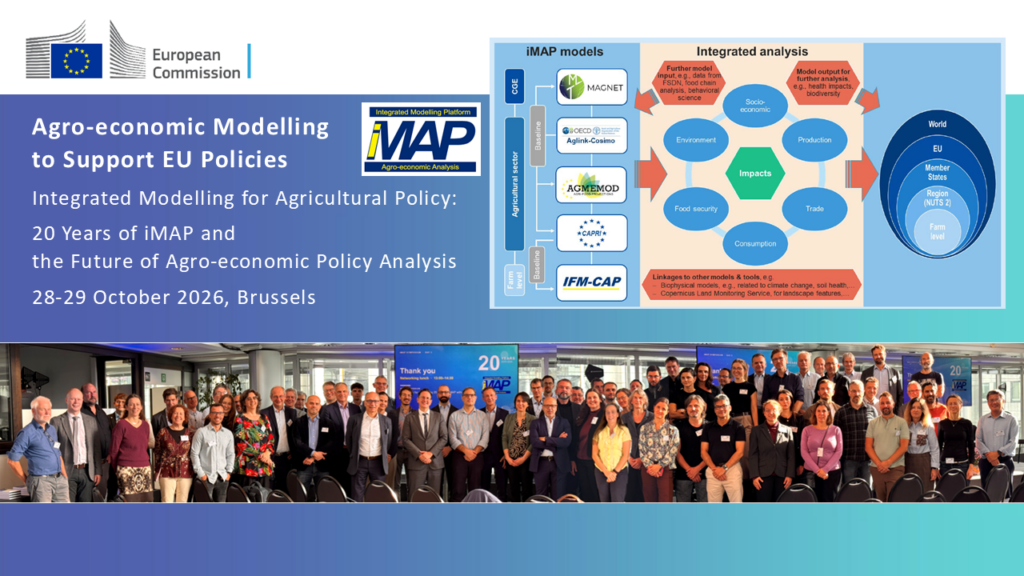
Brussels, 28–29 October 2026 — What analytical tools will be needed to assess the Common Agricultural Policy after 2027? How can modelling account for greater national flexibility, changing market conditions, environmental objectives and the diverse impacts of policy choices on farms and consumers? These questions featured prominently at the iMAP 20th Anniversary Symposium, Agro-economic Modelling to Support EU Policies: Integrated Modelling for Agricultural Policy Analysis.
The symposium brought together agricultural modellers, policymakers and representatives of international organisations to review the contribution of integrated modelling to EU policy development and discuss its future. A central message was that agricultural policy analysis must increasingly connect economic, environmental and social dimensions. The CAP’s objectives extend beyond farm income and production to include competitiveness, food affordability, climate and biodiversity outcomes, rural viability and resilience to external shocks.
The post-2027 policy framework presents particular analytical challenges. Greater discretion for Member States and the proposed integration of funding instruments into National and Regional Partnership Plans could make national policy choices more diverse and interconnected. Speakers questioned how EU-level models can assess these different approaches while also identifying their cumulative effects on European objectives. They emphasised the continuing need for common analytical frameworks capable of comparing national choices, identifying potential trade-offs and understanding their implications across regions, sectors and farm types.
Several discussions focused on how to improve the representation of farmers and consumers. Farm-level models need to capture differences in farm structures, investment decisions, technology adoption, risk management and behavioural responses to policy incentives. Participants also highlighted the importance of understanding who benefits from policy interventions and how changes in production and trade affect food prices and affordability for different consumer groups. Better representation of supply chains, processing, retail markets and price transmission was identified as an important area for further work.
The symposium also examined how models can respond to shocks and uncertainty. Recent geopolitical disruptions, energy and fertiliser price volatility, extreme weather and changing international trade relations demonstrate the need for timely scenario analysis and improved assessment of risks. Stochastic methods and complementary modelling approaches can help explore a wider range of possible outcomes. At the same time, speakers stressed that projections are conditional on assumptions and should not be communicated as predictions.
Technological developments offer further opportunities. AI, machine learning, satellite observations and model emulators can support data integration, improve parameter estimation, speed up simulations and enable more detailed analysis. However, the discussions repeatedly returned to the need for robust validation, transparency and traceability. More detailed outputs are useful only when supported by sufficiently reliable data and methods that researchers and policymakers can understand and scrutinise.
A final cross-cutting message concerned institutional capacity. Effective policy modelling depends on long-term expertise, cooperation between Commission services and research institutions, and the ability of national modelling communities to engage with European-level analysis. The symposium highlighted the value of independent, complementary modelling approaches and sustained collaboration between the JRC, national institutions, universities and international organisations.
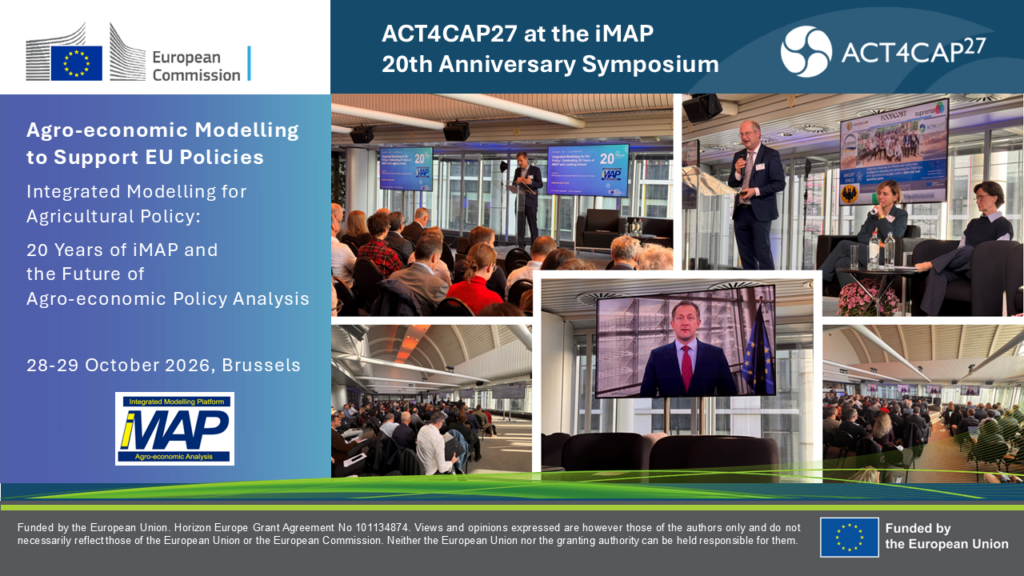
ACT4CAP27 was represented by partners from Wageningen Social & Economic Research (WSER), SLU, Thünen, IIASA, EuroCARE, Possessio, the Universidad Politécnica de Madrid (UPM), University Colllege London and the EC JRC. Scientific coordinator Hans van Meijl (WSER) contributed as a panellist and mentioned ACT4CAP27 when discussing European research initiatives that can help broaden the scope of agricultural modelling. Maria Blanco (UPM) and Petr Havlík (IIASA), both contributors to the project, also took part in the symposium discussions as pannellists.
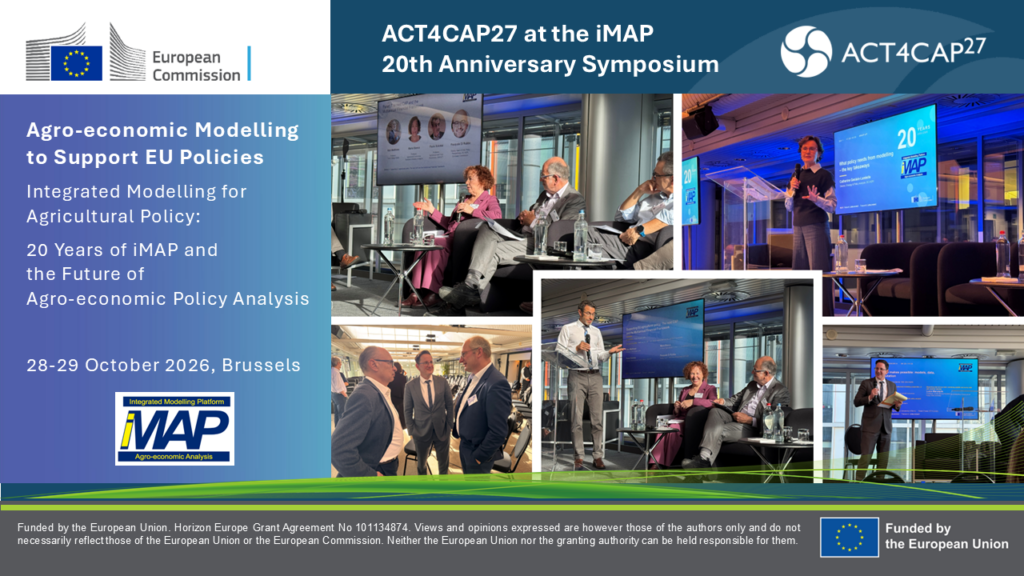
The participation of project partners, alongside representatives from several European Commission Directorates-General, FAO, OECD and the wider modelling community, provided valuable visibility and opportunities for exchange. While ACT4CAP27 results were not presented as dedicated project outputs, the symposium’s discussions closely aligned with the project’s work on alternative CAP pathways and their economic, environmental and wider societal implications. The event reinforced the importance of integrated modelling to assess policy options beyond 2027, understand their distributional consequences and provide evidence that is relevant to both EU-level and national policy debates.
Source: Possessio