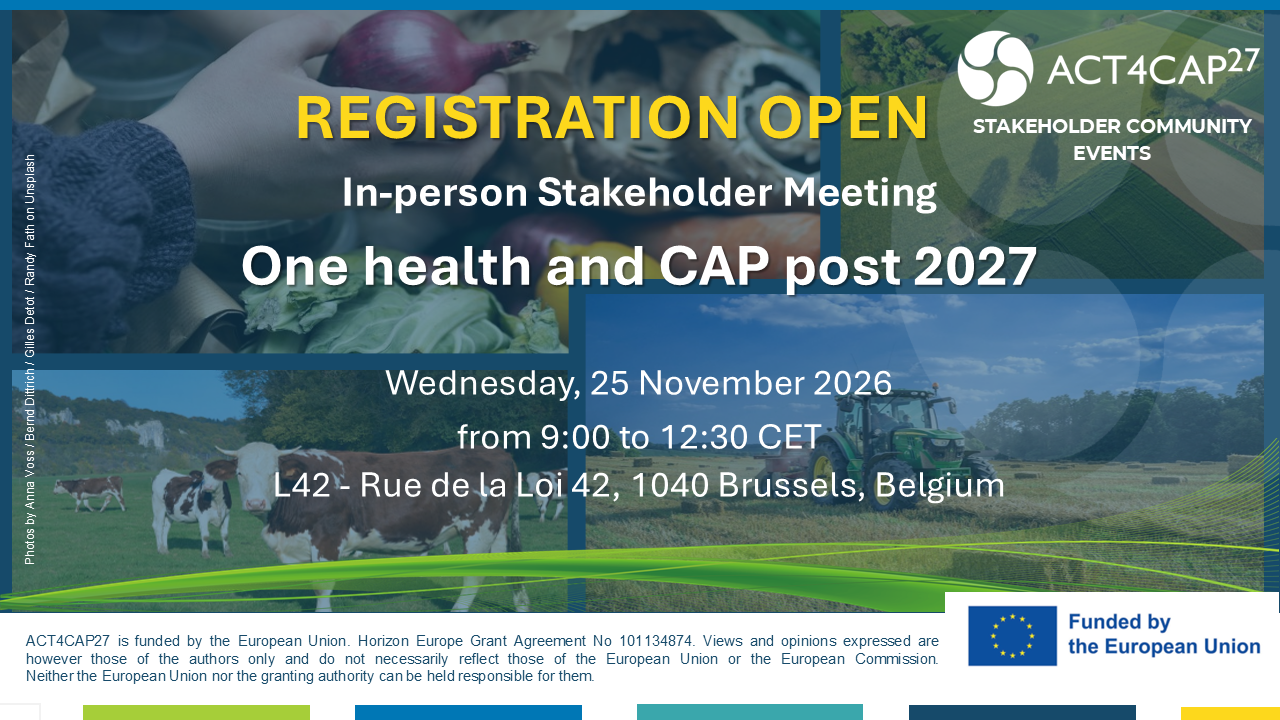
Brussels, 25 November 2026 – How can the Common Agricultural Policy (CAP) contribute to healthier people, healthier animals and a healthier environment? And how can policymakers assess the economic and wider societal consequences of different policy choices?
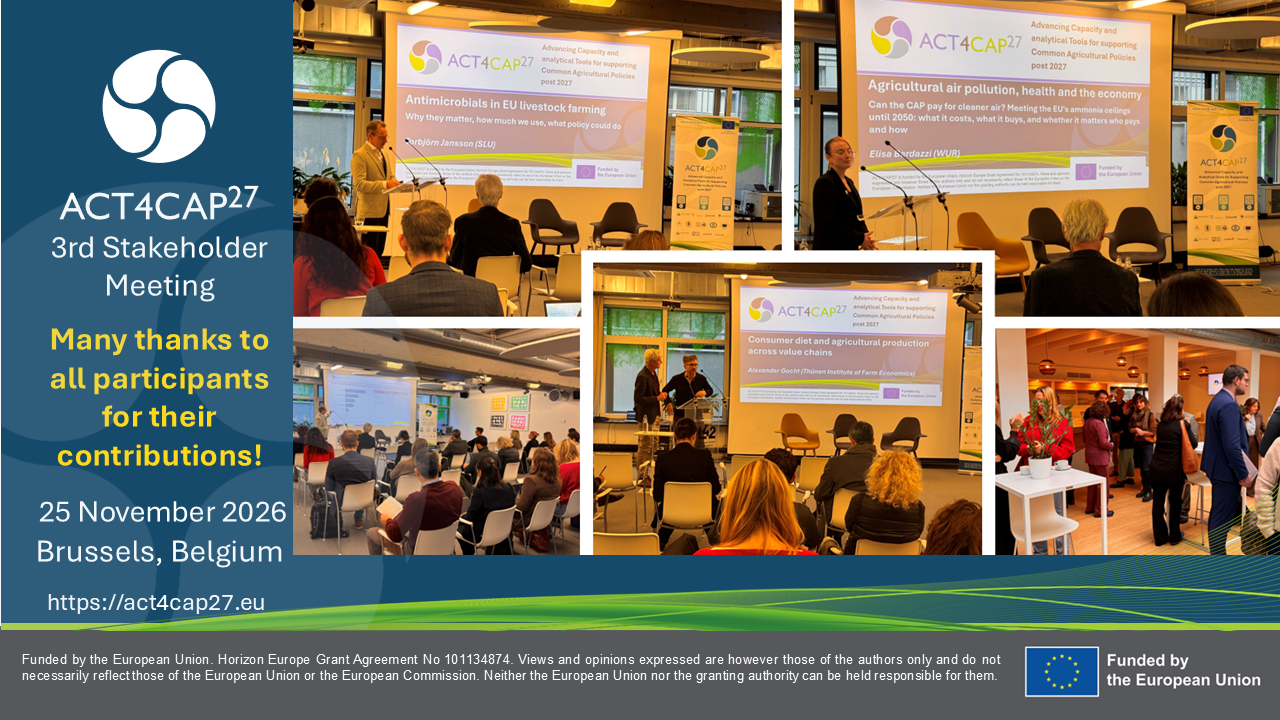
These questions brought together European policymakers, agricultural and food-sector representatives, health professionals, researchers and civil-society organisations at the ACT4CAP27 stakeholder meeting One Health and CAP post-2027, held in Brussels on 25 November 2026.
The meeting explored three interconnected policy challenges: reducing antimicrobial use in agriculture, understanding the relationship between consumer diets and agricultural production, and tackling air pollution from agricultural activities. Through recent developments in the project’s economic modelling work, we examined how policy interventions can affect agricultural production, markets, farm incomes, environmental pressures and human health – and what these connections mean for the design of the CAP after 2027.
Putting One Health into the CAP post-2027 debate
The discussions come at an important moment for European agricultural and food policy. The European Commission’s Vision for Agriculture and Food, the proposal for the CAP post-2027 and the new strategic approach to research and innovation under AgRI 2040 and Food 2040 all highlight the need to strengthen the resilience and competitiveness of European agriculture and food systems while addressing environmental, health and societal challenges.
The One Health perspective provides an important connection across these priorities. Human, animal and environmental health are interdependent, and agricultural policy can influence all three. The EU’s policy framework on antimicrobial resistance, including the 2023 Council Recommendation on stepping up action against AMR through a One Health approach, reinforces the need for coordinated action across sectors. Meanwhile, the National Emission Reduction Commitments Directive sets increasingly demanding obligations for Member States to reduce air pollutants, including agricultural ammonia emissions.
Against this policy background, ACT4CAP27 is developing and extending its modelling approaches to help assess the interactions between agricultural policy, production and wider societal outcomes. The stakeholder meeting offered an opportunity to discuss these developments and consider which policy questions and modelling results are most relevant to those shaping and implementing future agricultural policies.
Three policy challenges, interconnected impacts
Reducing antimicrobial use: balancing agricultural production and health protection
The first discussion examined how economic and policy instruments, including a potential fee on antimicrobial products, could influence antimicrobial use and agricultural production across the EU. The analysis considered differences in antimicrobial use between Member States, possible changes in livestock production and the implications of policy interventions for animal health, human health and the environment.
An important question was how to encourage more prudent antimicrobial use while maintaining animal health and the viability of agricultural production. Stakeholders discussed the relevance of different policy approaches and the potential for changes in production and trade to redistribute impacts across countries. The discussion highlighted why antimicrobial resistance requires a coordinated One Health response and why agricultural policy assessments need to consider effects beyond individual farms and sectors.
Connecting consumer diets with agricultural production across value chains
The second discussion explored the two-way relationship between food demand and agricultural production. Changing dietary preferences, food policies and consumer behaviour can influence demand for agricultural commodities, farm incomes and trade. At the same time, agricultural policies, production costs and technological developments can affect food prices and consumer choices.
To better capture these connections, ACT4CAP27 is extending the CAPRI model by linking agricultural market data with detailed food-intake information. This enables the analysis to move beyond aggregate commodity balances towards the foods people actually consume, including composite foods and their ingredients.
The approach was illustrated through modelling applications examining dietary changes towards the EAT-Lancet Planetary Health Diet and scenarios for reducing sugar consumption. Preliminary results demonstrate how changes in diets can have different consequences across agricultural sectors and Member States, with implications for livestock, sugar, dairy, cereals, fruit and vegetable production, farm incomes and greenhouse gas emissions.
For the CAP post-2027, this raises important questions about how agricultural policy can anticipate demand-side developments, account for their distributional effects and better connect food-related policy instruments with agricultural market responses.
Agricultural air pollution: linking cleaner air with public health and farm economics
The third discussion focused on ammonia emissions from agriculture and their contribution to fine-particle air pollution and associated health impacts. With agriculture responsible for around 95% of EU ammonia emissions, reducing these emissions is an important challenge for achieving the objectives of the National Emission Reduction Commitments Directive.
Using the MAGNET model, ACT4CAP27 examined the economic and health implications of meeting national ammonia emission ceilings up to 2050. The analysis compared different approaches to financing emission-reduction measures, including shared EU and national funding, national financing and farmers bearing the costs. It also explored the effects of introducing an EU-wide ammonia price.
The results illustrate important policy trade-offs. In the modelled scenarios, meeting national emission ceilings could avoid approximately 4,000 premature deaths annually by 2050, compared with a future without these ceilings. Combining the ceilings with an EU-wide ammonia price could increase the estimated health benefit to around 16,000 avoided deaths annually, although at substantially higher economic cost.
The analysis also shows that the choice of who pays has implications for the distribution of costs between Member States and farmers, while the policy instrument itself influences the scale and geographical distribution of emission reductions. These findings provide a basis for discussing how the CAP could support cleaner air, how funding responsibilities should be shared and how agricultural and environmental objectives can be pursued together.
The figures presented are conditional model results based on specified assumptions and scenarios. They illustrate possible outcomes and should not be interpreted as forecasts.
From modelling evidence to policy-relevant research: stakeholders shape the next steps
A central objective of the meeting was to connect the project’s modelling developments with the knowledge, priorities and practical experience of those involved in European agriculture, food, health and environmental policy.
We were pleased to welcome representatives from a broad range of European and national organisations, including Ordem dos Médicos Veterinários (Portugal), Animal Health Europe, the European Consumer Organisation (BEUC), the International Confederation of European Beet Growers (CIBE), Friends of the Earth Europe, EuroCommerce, FoodDrinkEurope, the Austrian Chamber of Agriculture, Mars, the Permanent Representations of Luxembourg and Austria to the EU, the European Commission’s DG SANTE, DG AGRI, DG ENV and DG COMP, the Public Service of Wallonia – Agriculture, Natural Resources and Environment, and the European Research Executive Agency (REA).
Their perspectives helped bring different dimensions of the One Health challenge into the discussion, from veterinary and animal-health considerations to consumer interests, agricultural competitiveness, environmental protection, market developments and the practical implications of future policy instruments.
We sincerely thank all participants for their time, expertise and constructive contributions. Their views are valuable in shaping our research questions, refining our modelling approaches and ensuring that the results address the issues that matter to policymakers and stakeholders across the agricultural and food value chains.
The exchanges also reinforced the importance of examining policy impacts across sectors, regions and stakeholder groups. Questions around the distribution of costs, the interaction between consumer demand and farm production, the effectiveness of policy instruments and the balance between national and EU-level responsibilities will continue to inform ACT4CAP27’s work.