ACT4CAP27 represented at the Forum for the Future of Agriculture Market Outlook Workshop
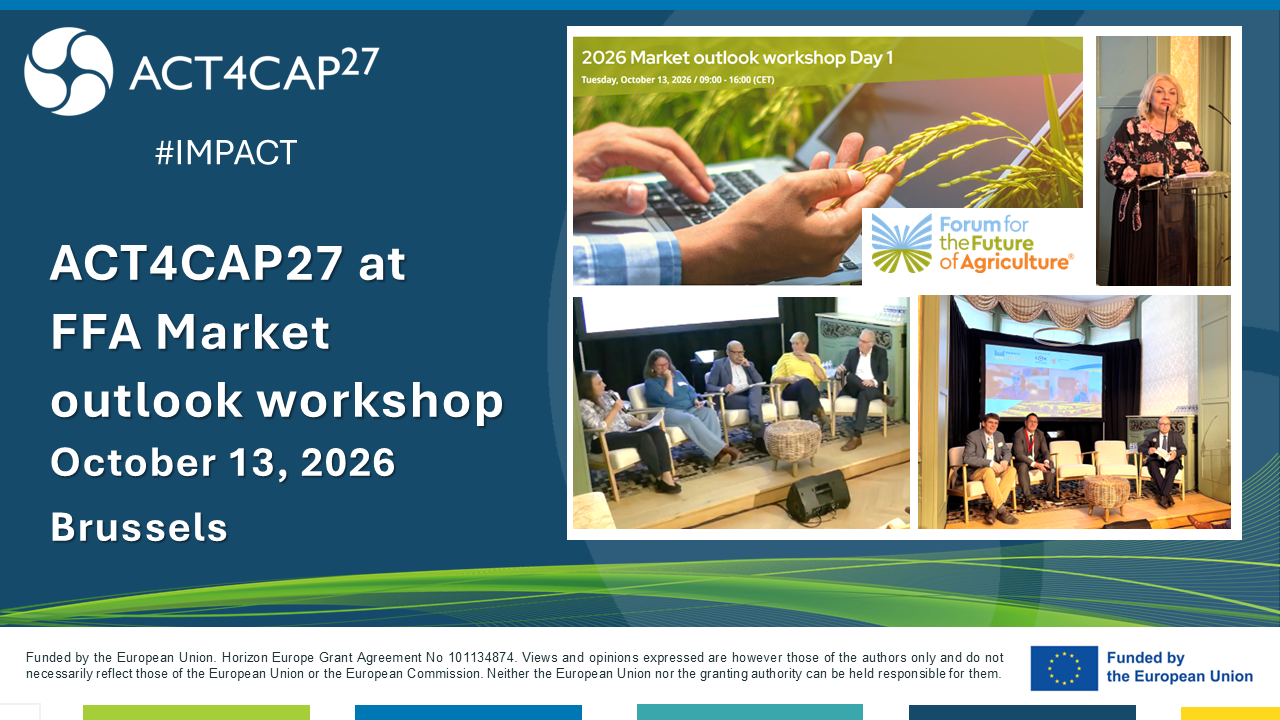
How should European agricultural policy respond when energy costs, international markets, environmental pressures and farm competitiveness interact? This question was central to the 2026 Market Outlook Workshop organised by the Forum for the Future of Agriculture in Brussels on 13 October.
Katalin Balázs, COMDISS Leader, represented ACT4CAP27, BrightSpace and NatuRISE projects in the panel “What if? Three scenarios for EU agriculture”. The discussion brought complementary research perspectives into a stakeholder debate about the forces shaping European agriculture and the choices facing policymakers.
For ACT4CAP27, the workshop addressed a central challenge for the Common Agricultural Policy (CAP) after 2027: policy decisions need to be assessed across interconnected economic, social and environmental outcomes. Changes in energy prices, agricultural production, trade and land use can reinforce or offset one another, making it difficult to understand the implications of an individual policy measure in isolation.
ACT4CAP27 is developing an integrated analytical toolbox that builds on agricultural economic models, including CAPRI, GLOBIOM, MAGNET and AGMEMOD, to strengthen the assessment of future EU agri-food policies. Its work explores how different policy choices and developments could affect agricultural markets, farm performance, resource use and wider societal objectives.
The workshop’s discussion of energy-price shocks illustrated why this integrated perspective matters. A rise in input costs can affect production decisions and the use of agricultural land, while international trade can shift production and environmental pressures beyond EU borders. The scale and distribution of these effects depend on the assumptions used, market conditions and potential policy responses.
The takeaway for ACT4CAP27 is that policy assessments need to capture interactions and trade-offs, not just individual impacts. Credible evidence for the post-2027 CAP should help policymakers understand who bears the costs of adjustment, how outcomes differ across regions and farming systems, and whether apparent improvements in one area create pressures elsewhere.
The policy message is to strengthen evidence-based decision-making through integrated modelling, transparent assumptions and dialogue with stakeholders. Scenario analysis can help decision-makers compare possible futures and understand the consequences of alternative choices before policies are implemented.
We thank the Forum for the Future of Agriculture organisers for inviting ACT4CAP27, BrightSpace and NatuRISE to be featured in this timely discussion. Connecting research with the policy and agricultural communities is essential for ensuring that analytical evidence addresses the questions facing Europe’s agricultural future.