
The Ukraine Fast Track scenario examines how a defined pathway towards EU membership in 2030 could affect Ukraine’s agrifood sector and the wider European food system.
The central message is that EU accession would not affect only trade policy or agricultural production in Ukraine. It could influence economic growth, investment, land availability, input use, demographics, prices, production, trade and market integration at the same time.
ACT4CAP27 helps explore these interconnected effects by comparing the Fast Track accession pathway with a baseline scenario under consistent assumptions.
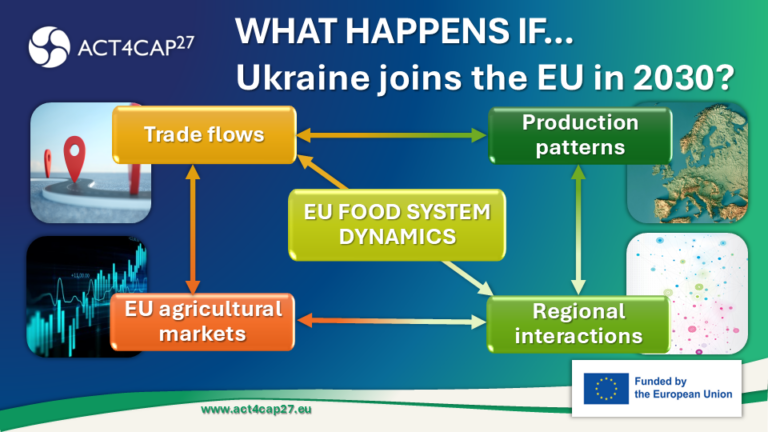
Ukraine’s European integration is one of the most consequential questions facing the future of European agriculture and food systems. Ukraine is a major agricultural producer with substantial land resources, strong production capacity in several commodities and a strategic position in European and global food markets.
Accession would bring major changes to the framework in which Ukrainian agriculture operates. EU membership could affect economic growth, trade, agricultural production, access to inputs, farm competitiveness, prices and demographic trends. It would also connect Ukraine directly to the Common Agricultural Policy and the EU Single Market.
These changes would have consequences beyond Ukraine. Policymakers need to understand how accession could affect agricultural markets, producers, consumers and the wider European food system.
What could happen to Ukraine’s agrifood sector and the wider European food system if Ukraine completes a fast-track accession process and becomes an EU Member State in 2030?
ACT4CAP27 examines how a fast-track accession pathway could influence Ukraine’s agrifood sector over the period 2025–2035.
The scenario considers changes in:
The analysis compares the accession pathway with a baseline in which Ukraine does not become an EU Member State during the projection period. This makes it possible to examine the potential consequences associated with a major change in policy and market conditions.
The Fast Track accession scenario points towards a stronger economic and agricultural recovery trajectory than the baseline.
By 2035, the scenario assumes:
The scenario also illustrates the scale of Ukraine’s integration into European agriculture. Ukraine’s agricultural production capacity is significant in relation to the EU market, particularly for crops such as maize, wheat, rapeseed and sunflower seed.
The results therefore point to effects that extend beyond Ukraine. Changes in production, trade, prices and competitiveness can influence agricultural markets and policy considerations across the EU.
The scenario describes a possible pathway based on defined assumptions. It is not a forecast of the outcome of the accession process.
EU accession is not a single agricultural policy measure. It can influence several parts of the economy and food system at the same time.
Economic growth can affect investment and farm competitiveness. Improved access to finance and technology can influence production. Trade liberalisation can change market opportunities and competitive pressures. EU membership can alter agricultural policy support and market conditions. Demographic changes can affect both the agricultural workforce and food demand.
These effects interact.
A change in one part of the system can generate consequences elsewhere. For example, stronger economic growth may increase investment and input use, while market integration can simultaneously change trade flows, prices and competitive conditions.
An integrated assessment helps policymakers examine these interactions together and identify where potential benefits, pressures and trade-offs may emerge.
ACT4CAP27 connects economic, agricultural, trade, demographic and market perspectives to examine the wider implications of a major policy pathway.
The analysis provides a common framework for comparing alternative futures under consistent assumptions. This helps make the consequences of different policy conditions more visible across multiple dimensions of the agrifood system.
The added value lies in the ability to examine connected effects:
This supports a more complete understanding of how major policy choices can shape agricultural systems over time.
The Fast Track accession scenario is not intended to determine whether or when Ukraine should join the European Union.
Its purpose is to help explore the implications of a defined accession pathway.
By comparing a baseline and an accession scenario, policymakers and stakeholders can ask:
Scenario analysis provides a structured way to explore these questions before policy decisions are made and while policy options are still being developed.
The scenario analysis has potential relevance for several European Union policy areas.
***
EU enlargement and accession policy
The scenario can support evidence-informed consideration of the possible economic and sectoral implications of Ukraine’s future EU membership.
The European Commission identifies agriculture and rural development as a particularly complex and sensitive area of enlargement. Accession requires alignment with the CAP, the development of administrative capacity and the integration of agricultural markets into the EU framework.
Potential influence: The analysis can provide an evidence base for assessing possible agricultural and market implications of different accession pathways and for identifying areas requiring further preparation, transitional arrangements or policy analysis.
***
Common Agricultural Policy and agricultural market policy
EU membership would bring Ukraine within the Common Agricultural Policy framework and the EU agricultural market system. The Commission notes that accession negotiations in agriculture address future CAP support, rural development, market mechanisms and the administrative systems required to implement agricultural policy.
Potential influence: The results can inform analysis of how Ukraine’s accession could interact with CAP implementation, agricultural market balances, production incentives, farm competitiveness and the design of possible transitional arrangements.
The scenario also has relevance to the development of the CAP after 2027, where the Commission has emphasised income support, investment, agri-environmental measures and crisis support as components of the future policy framework.
***
EU internal market and agricultural trade
The Fast Track scenario assumes full integration of Ukraine into the EU Single Market from accession.
This is relevant to the future treatment of agricultural products, trade flows, market access and the competitive relationship between Ukrainian and EU producers. The Commission describes Ukraine’s accession process as involving alignment with EU legislation and standards, while the upgraded EU–Ukraine DCFTA provides a current framework for deeper trade liberalisation and alignment ahead of possible membership.
Potential influence: The analysis can support assessment of possible changes in agricultural trade, production specialisation, market competition and price formation associated with deeper EU–Ukraine integration.
***
Food security and resilience
Ukraine is a major agricultural producer and an important participant in international food markets. Changes in Ukrainian production and trade can have implications for European and international food supply chains.
Potential influence: The scenario can contribute to assessments of how European integration could affect the resilience, diversification and functioning of agricultural supply chains, particularly under changing geopolitical and economic conditions.
***
Rural development and agricultural structural change
EU accession can affect investment, farm competitiveness, access to technologies and the wider economic conditions in rural areas.
Potential influence: The analysis can support consideration of how agricultural and rural development policies may need to respond to structural change, differences in farm scale and productivity, and the integration of a large agricultural producer into the EU market.
***
Evidence for accession-related policy preparation
The Commission’s accession process includes detailed examination of Ukraine’s alignment with the EU acquis across policy fields, including agriculture, food safety and related administrative capacities. The screening process provides a technical basis for assessing preparedness for membership.
Potential influence: The scenario analysis can complement legal and institutional accession assessments by examining the potential economic and agrifood-system consequences of alternative future conditions.
The scenario analysis can be relevant to:
The analytical result can be used to:
The scenario can also serve as a starting point for more detailed analyses of specific policy areas, commodities, regions or stakeholder groups.
The Fast Track accession scenario provides a structured analytical foundation that can be developed further as the policy context changes.
Future applications could include:
This creates potential for the scenario framework to support continued policy analysis beyond the initial ACT4CAP27 assessment.
Ukraine’s EU accession could reshape both Ukraine’s agrifood sector and the wider European agricultural market. ACT4CAP27 helps policymakers explore these interconnected effects by comparing alternative future pathways within an integrated analytical framework.
The Ukraine Fast Track scenario examines how a defined pathway towards EU membership in 2030 could affect Ukraine’s agrifood sector and the wider European food system.
The central message is that EU accession would not affect only trade policy or agricultural production in Ukraine. It could influence economic growth, investment, land availability, input use, demographics, prices, production, trade and market integration at the same time.
ACT4CAP27 helps explore these interconnected effects by comparing the Fast Track accession pathway with a baseline scenario under consistent assumptions.
The analysis compares two possible pathways for Ukraine over 2025–2035:
The comparison examines implications for macroeconomics, agricultural land availability, fertiliser use, demographics, agricultural policies, trade and price transmission.
No. It is a scenario analysis, not a forecast.
The analysis asks: What could happen under a defined set of assumptions?
The results depend on assumptions concerning the timing of accession, economic growth, currency developments, inflation, land availability, input access, demographics, trade integration and agricultural policy.
If these assumptions change, the results may also change.
2030 is used as the target accession year in the Fast Track scenario. It provides a clearly defined point at which the policy and market framework changes.
This allows the analysis to distinguish between:
The year should therefore be understood as a scenario assumption, not as a prediction of the actual timing of accession.
The baseline represents a future in which Ukraine does not become an EU Member State during the projection period.
The baseline nevertheless assumes gradual post-war recovery and continued development of Ukraine’s economy and agricultural sector.
The Fast Track scenario therefore does not compare accession with permanent economic stagnation. It compares two different possible future trajectories.
From 2030 onwards, the Fast Track scenario assumes that Ukraine:
The scenario also assumes stronger economic growth, improved access to agricultural inputs and a more favourable demographic trajectory than in the baseline.
Not yet in the current Fast Track scenario.
The scenario assumes that the Common Agricultural Policy applies to Ukraine after accession, but the allocation of future CAP funding to Ukraine has not yet been included in the current scenario assumptions.
This is an important area for further development of the accession scenario.
The current analysis captures the structural change associated with EU membership, including market integration and the application of the CAP framework. The detailed allocation of future CAP funding to Ukraine is a further scenario dimension that should be incorporated in subsequent analysis.
Ukraine is a major agricultural producer with substantial agricultural land and significant production volumes for several commodities.
Its accession would therefore affect the scale and composition of the EU agricultural market.
The analysis considers Ukraine as an additional member of the integrated European market and examines how changes in production, consumption, trade and prices may interact with the wider EU market.
No.
The model analyses price formation and market responses under the assumptions of each scenario.
The results should be interpreted as the consequences of the specified scenario conditions, not as precise predictions of future market prices.
Price outcomes depend on several interacting factors, including:
Ukraine’s accession would affect multiple parts of the food system simultaneously.
For example:
Looking at only one of these dimensions would provide an incomplete picture.
The scenario provides evidence for considering the possible agrifood-system implications of Ukraine’s future EU integration.
It can support discussions about:
The Fast Track scenario produces a more favourable trajectory for several indicators, including economic growth and agricultural production conditions.
However, the analysis should not be reduced to a simple “positive” or “negative” conclusion.
Accession creates opportunities and adjustment pressures simultaneously.
For example, stronger economic growth and improved market access may create opportunities, while increased competition and structural adjustment may create pressures for some producers and sectors.
The analysis does not provide a simple overall ranking of winners and losers.
The consequences of accession may differ across:
This is precisely why integrated assessment is important.
The scenario assumes that the CAP applies to Ukraine after accession.
This raises important policy questions concerning:
The current scenario provides a framework for examining the wider implications, but detailed CAP budget allocation to Ukraine remains a further area for analysis.
The Fast Track scenario includes several drivers that can affect environmental outcomes, including:
The current scenario is primarily focused on the economic and agrifood-system implications of accession. Specific environmental and climate consequences require further analysis using appropriate indicators and scenario assumptions.
The scenario is relevant to food security because Ukraine is a significant agricultural producer and exporter.
Changes in Ukrainian production and trade could affect:
However, food security is multidimensional. Production volumes alone do not determine food security.
The scenario is based on the analytical work and assumptions developed within ACT4CAP27, drawing on available economic, agricultural, demographic and policy information.
Stakeholder knowledge is particularly relevant for assumptions concerning:
Stakeholders can use the scenario to:
Yes, particularly through representative organisations and sectoral stakeholders.
The scenario can help farmers and producer organisations understand possible changes in:
The results should not be interpreted as farm-level forecasts.
Stakeholders can contribute by:
The scenario is designed to be relevant to multiple actor groups, including:
The value of stakeholder involvement is particularly important when developing and testing future scenario assumptions.
The scenario can provide a starting point for further policy analysis.
Possible future developments include:
Potentially, yes. The scenario framework can be reused to examine alternative assumptions and policy pathways.
Further development could include:
The result has potential value as a reusable scenario-based analytical framework for assessing the agrifood-system implications of Ukraine’s European integration.
Potential users include:
The framework can support future comparisons of accession pathways and policy options as the political and economic context evolves.