
The central policy message is that digitalisation policy should be evidence-based and targeted. Understanding which technologies can deliver relevant benefits, under what conditions, and with what adoption barriers is essential for designing effective support for a competitive and sustainable EU agricultural sector.
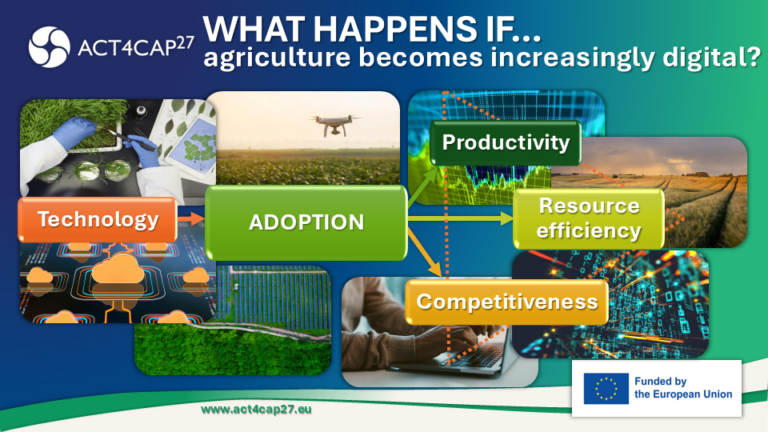
European agriculture is under pressure to remain competitive, resilient and sustainable while responding to changing climate conditions, volatile markets and growing demands for efficient resource use. Digital technologies can support farmers in monitoring production, improving decision-making and using inputs more efficiently. However, the uptake of advanced technologies remains uneven across European agriculture.
The central policy challenge is therefore not simply whether digital technologies exist, but how their uptake can be supported, under what conditions, and with what consequences for farm performance and competitiveness. Investment costs, digital skills, access to knowledge and data governance can all influence whether farmers are able to benefit from the digital transition.
The European Commission identifies digitalisation as an important contributor to the modernisation, competitiveness and sustainability of agriculture and rural areas. The CAP 2023–27 also includes a cross-cutting objective to foster knowledge, innovation and digitalisation in agriculture and rural areas.
What could happen if digitalisation accelerates across European agriculture, and which policy conditions could help farmers turn technological progress into improved competitiveness and resource efficiency?
ACT4CAP27 investigates how wider adoption of selected digital technologies could influence key aspects of agricultural performance towards 2035.
The analysis considers evidence on technologies including digital decision-support tools, farm management software, automated and precision technologies, satellite and remote-sensing applications, livestock monitoring systems and other data-driven tools.
The assessment focuses on measurable impacts identified in the scientific literature, including:
The analysis brings together projected technology adoption patterns and evidence on technology performance to support the assessment of possible future digitalisation pathways.
The scenario analysis provides an evidence base for examining the consequences of different levels and patterns of digital technology uptake across European agriculture. It connects projected adoption rates with quantitative evidence on technology performance gathered from systematic reviews and meta-analyses.
The evidence base shows that digitalisation is not a single technology or uniform transition. Adoption levels differ substantially between technologies and regions, with some basic digital tools already widely used while more advanced technologies remain less widespread.
The analysis therefore helps assess a central policy issue: how the wider diffusion of advanced digital technologies could influence agricultural productivity, input efficiency and the economic performance of farms.
The results also highlight the importance of considering adoption conditions alongside technology performance. The potential contribution of digitalisation depends on farmers’ ability to access technologies, acquire the necessary skills and operate within trusted and interoperable data environments.
Digitalisation can influence several dimensions of agricultural performance at the same time. A technology may affect yields, input use, labour requirements, investment costs and farm management practices. The scale and direction of these effects can also vary between technologies and regions.
This makes integrated assessment important for policy development. Supporting technology uptake involves choices about investment, skills, knowledge exchange, infrastructure and data governance, and these choices may influence who can adopt technologies and how effectively they are used.
Assessing the potential consequences across several indicators helps policymakers consider both the expected benefits and the conditions required for those benefits to materialise.
The ACT4CAP27 approach connects technology adoption evidence with quantitative evidence on technology impacts.
It combines:
This creates a structured evidence base for assessing possible digitalisation pathways and for exploring how technology uptake could contribute to the competitiveness and efficiency of EU agriculture.
The approach is designed to make the evidence supporting scenario assumptions traceable and usable for future policy analysis.
The digitalisation scenario does not prescribe a single technology or policy instrument. It provides a framework for exploring the consequences of different patterns of technology adoption.
This can support questions such as:
The value of the scenario lies in supporting structured comparison of possible future pathways before policy choices are implemented.
The scenario has potential relevance for EU policy areas concerned with agricultural competitiveness, digitalisation, research and innovation, knowledge exchange, rural development and data governance.
Common Agricultural Policy
The strongest direct policy connection is with the CAP objective of enhancing market orientation and increasing farm competitiveness, including through greater focus on research, technology and digitalisation. Regulation (EU) 2021/2115 also establishes the cross-cutting objective of modernising agriculture and rural areas through knowledge, innovation and digitalisation, including the uptake of digital farming technologies.
Potential policy influence: The scenario evidence can inform the design and targeting of measures that support digital technology adoption, farm modernisation, knowledge exchange, training and advisory services. It can also help assess whether proposed support mechanisms are aligned with technologies that have demonstrated potential impacts on productivity, input efficiency or farm performance.
The European Commission’s overview of digitalisation in agriculture identifies CAP instruments including investment support, eco-schemes, sectoral interventions, advisory services, cooperation and knowledge exchange as relevant tools for advancing digitalisation.
***
EU digitalisation policy for agriculture and rural areas
The European Commission describes digitalisation as supporting the modernisation, competitiveness and sustainability of agriculture, including through digital technologies and data-driven approaches. The Commission also highlights the importance of infrastructure, training, skills development and the uptake of advanced technologies.
Potential policy influence: The scenario can provide quantitative evidence to support future discussions on the prioritisation of digital technologies, the conditions for their uptake and the expected contribution of digitalisation to agricultural competitiveness and resource efficiency.
The Commission’s Vision for Agriculture and Food also identifies the development of an EU digital strategy on agriculture as an area of action and stresses the importance of research, innovation, knowledge exchange, digital skills and the uptake of digital tools for the future competitiveness of the sector.
***
Research and innovation policy
The scenario supports the policy objective of strengthening the connection between research evidence, technological innovation and practical agricultural uptake.
Potential policy influence: The evidence base can help identify where further research is needed, where technologies show promising performance evidence and where gaps remain in understanding their economic and operational impacts across different agricultural contexts.
This is relevant to the Commission’s stated objective of strengthening research, innovation and knowledge exchange in support of a competitive, sustainable, resilient and fair agri-food sector.
***
Data governance and the digital transition
The digitalisation of agriculture depends on the generation, access, exchange and use of data from connected products and services. Regulation (EU) 2023/2854, the Data Act, establishes harmonised rules concerning, among other matters, access to data generated by connected products and related services, data sharing and interoperability. The Regulation explicitly covers connected products including agricultural machinery and establishes provisions concerning access to product and related service data.
Potential policy influence: The scenario reinforces the importance of considering the enabling conditions for data-driven agriculture, including data access, interoperability, data literacy and trusted data governance, when designing future digitalisation policies.
The policy relevance is therefore broader than technology deployment alone: the benefits of digitalisation depend partly on the institutional and technical conditions under which agricultural data can be accessed, interpreted and used.
***
Rural development and territorial cohesion
Digitalisation can contribute to the modernisation of rural areas and the development of new opportunities for agricultural businesses and rural communities. The European Commission identifies digital technologies as relevant to rural development and to reducing the digital divide between rural and urban areas.
Potential policy influence: The scenario can support consideration of regional differences in technology uptake and the need for policies that address uneven access to technologies, skills and digital infrastructure.
Who can use this result?
The evidence and scenario framework can be relevant to:
The scenario analysis can be used as an evidence base for future policy exploration and strategic discussion.
Potential uses include:
The underlying evidence structure can also be updated as new scientific findings, adoption data and stakeholder evidence become available.
The digitalisation scenario demonstrates how evidence on technology performance can be connected with future adoption pathways to support policy analysis.
Its future potential lies in the possibility of extending the evidence base, updating technology adoption assumptions and applying the indicator framework to new policy questions. This could support the continued assessment of how digital technologies contribute to agricultural productivity, competitiveness and resource efficiency under changing economic, environmental and policy conditions.
The approach can therefore provide a basis for further exploitation through future policy analysis, scenario development, evidence synthesis, stakeholder engagement and knowledge exchange.
Digitalisation can contribute to the competitiveness and efficiency of European agriculture, but its potential depends on which technologies are adopted, how widely they are taken up and whether farmers have the investment, skills, knowledge and trusted data conditions needed to use them effectively.
Digitalisation can contribute to the competitiveness and sustainability of EU agriculture, but its potential depends on which technologies are adopted, how widely they are taken up, and whether farmers have the investment capacity, skills and trust needed to use them effectively.
ACT4CAP27 investigates these potential effects by linking technology adoption trajectories with evidence on impacts such as productivity, input efficiency and adoption costs. The scenario helps explore how faster digitalisation could affect agricultural performance across different EU regions and technology groups.
What could happen if digitalisation accelerates across European agriculture?
The scenario explores how increasing adoption of selected digital technologies could influence agricultural productivity, resource efficiency and the economic performance of farms.
Digitalisation is not a single technology or a single policy. Its effects depend on which tools farmers adopt, how quickly adoption expands, and whether policy helps overcome barriers to investment, skills and trust.
The analysis investigates the potential impacts of a range of digital technologies used in crop and livestock production. These include technologies such as:
The analysis focuses on evidence related to agricultural productivity, input efficiency, operational and investment costs, and technology adoption.
Throughout this scenario a database of new technologies is being developed which complements the existing databases in the EU agricultural models, and allows all those models to update/extend their technology portfolio.
No. The scenario is an analytical exploration of possible consequences under specified technology-adoption trajectories. The results should be understood as scenario-based evidence, not as a prediction that a particular future will necessarily occur.
The scenario investigates potential technology adoption and impacts towards 2035.
The working paper uses empirical evidence from the JRC study on the state of digitalisation in EU agriculture, together with technology information from the BrightSpace project, to establish a baseline inventory and regional adoption profiles. These are used to construct technology-specific adoption trajectories towards 2035 across four EU macro-regions: East, North, South and West.
Digital technologies do not have the same adoption potential everywhere. Differences in farming structures, production systems, infrastructure, investment capacity and existing levels of digitalisation can influence how quickly particular technologies are adopted.
The scenario therefore considers adoption across different EU macro-regions, rather than assuming that one uniform adoption pathway applies to all farms.
The analysis systematically searches the Web of Science and Scopus databases, focusing on systematic reviews and meta-analyses where available. The evidence is screened against predefined criteria, and relevant quantitative indicators are extracted from the selected literature.
The extracted evidence concerns, among other things:
The final evidence is then manually checked before being used for scenario analysis.
They provide a way of drawing on a broad body of existing research rather than relying on individual case studies. This supports a more structured and transparent evidence base for identifying potential technology impacts.
No. The purpose is to identify and quantify potential impacts based on available evidence. Technologies differ in their effects, costs, adoption barriers and applicability across farming systems.
The scenario therefore does not assume that digitalisation automatically produces the same benefits everywhere.
Some technologies have limited evidence available, low projected adoption or overlapping impacts. Consolidating related technologies helps create a more robust analytical structure and avoids giving disproportionate weight to isolated evidence.
The final analysis therefore focuses on selected technology categories for which the evidence base is sufficiently relevant for indicator extraction and scenario development.
Digitalisation affects the ability of farmers to access information, manage resources, improve production decisions and respond to changing environmental and economic conditions.
However, advanced technologies can require substantial investment, specialised skills and trusted systems for managing farm data. Policy therefore influences whether digitalisation becomes broadly accessible or remains concentrated among farms with greater financial and technical capacity.
The working paper identifies three important barriers:
The scenario provides evidence that can help assess how agricultural policy instruments could support the uptake of digital technologies while considering wider economic and sustainability objectives.
Relevant policy support can include investment support, knowledge exchange, advisory services, training and measures that strengthen trust, interoperability and responsible data governance.
No. The analysis does not establish that all technologies should receive the same level or type of support.
Its value is to provide evidence on potential impacts and adoption conditions so that policymakers can assess which technologies, under which conditions, may contribute most effectively to policy objectives.
Yes, this is a relevant policy consideration. Technologies with high initial costs may be easier for larger or better-capitalised farms to adopt. Without appropriate support, skills provision and accessible services, digitalisation could contribute to a technology divide.
This is why the scenario considers not only potential technology impacts but also adoption barriers and regional differences.
Potentially, depending on the technology and its use. Data-driven systems can support more precise use of inputs such as fertilisers, pesticides and water. However, the environmental outcome depends on actual adoption, implementation and farm management decisions.
The scenario therefore examines input efficiency as one of the relevant impact dimensions.
No. Digital technologies can support the implementation of environmental objectives and improve resource management, but digitalisation itself does not replace environmental targets or policy instruments.
The scenario uses empirical information on the current state of digitalisation and adoption barriers in EU agriculture. The analysis also considers regional differences in technology uptake and the practical conditions influencing adoption.
The final indicators are intended to be validated through stakeholder engagement involving experts and agricultural-sector representatives.
Farmers are the primary users and adopters of the technologies considered. Their investment capacity, skills, operational needs and trust in digital systems directly influence whether potential benefits can be realised.
Farm organisations can use the evidence to:
Advisory services are important for translating technology potential into practical farm decisions. They can help farmers select appropriate tools, interpret data and integrate digital systems into existing production practices.
Technology providers can use the evidence to better understand the types of impacts and adoption conditions relevant to agricultural users.
The scenario also highlights the importance of interoperability, data governance and trust in the wider digital ecosystem.
Literature-based evidence needs to be considered alongside practical experience. Stakeholder validation helps assess whether the identified indicators and technology impacts are relevant under real farming conditions and across different agricultural contexts.
No. One important policy question is how digital technologies can become accessible to different types and sizes of farms. Investment costs, skills and access to advisory support are particularly important when considering the participation of smaller and family farms.
The work develops a structured evidence base linking:
digital technologies → adoption trajectories → empirical impact indicators → potential agricultural outcomes.
This provides a basis for analysing how changes in digital technology uptake may affect agricultural productivity, input efficiency and economic performance.
The evidence base could support:
Potentially, yes. The structured collection of technology impact indicators and adoption information could provide a reusable evidence base for future modelling and policy analysis, subject to continued validation, updating and appropriate documentation.
The approach can help policymakers examine questions such as:
No. Digital technologies evolve rapidly. Adoption rates, costs, performance and user experience can change over time. The evidence base therefore has value as a structured and updateable resource rather than as a permanent fixed estimate.
The methodology and structured evidence base could potentially support future digitalisation impact assessment, scenario exploration and evidence-informed policy design concerning agricultural technology adoption.
The key exploitation potential lies in making technology-impact evidence more accessible and usable for integrated agricultural policy analysis.