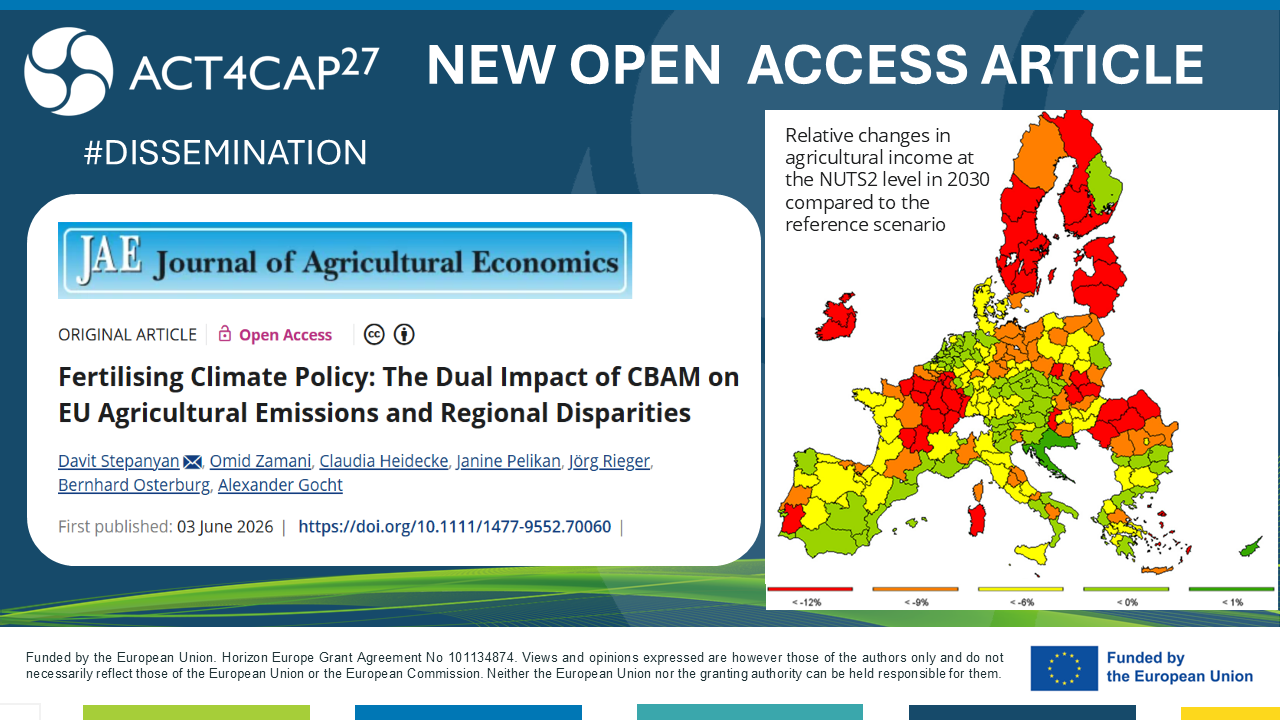
A new open-access scientific article produced within the Horizon Europe project ACT4CAP27 provides the first comprehensive assessment of how the EU’s Carbon Border Adjustment Mechanism (CBAM) and reforms to the EU Emissions Trading System (ETS) may affect agriculture through fertiliser markets.
Published in the Journal of Agricultural Economics, the study by Davit Stepanyan and colleagues explores an increasingly important policy question: how climate policies targeting industrial emissions can indirectly influence farming, agricultural incomes, food production, and greenhouse gas emissions across Europe.
Why does this matter?
The EU’s climate agenda is entering a new phase. Since January 2026, the Carbon Border Adjustment Mechanism (CBAM) has begun to complement the EU ETS by applying carbon costs to imports of selected carbon-intensive products, including mineral nitrogen fertilisers.
Although agriculture itself is not currently covered by the EU ETS, farmers depend heavily on fertilisers whose production is energy-intensive and already regulated under climate legislation. As free emission allowances for fertiliser producers are gradually phased out, fertiliser prices are expected to increase.
This raises several critical policy questions:
- How will higher fertiliser prices affect farm incomes?
- What are the implications for agricultural production and food security?
- Can climate policies reduce emissions without simply shifting production and emissions abroad?
- How should future Common Agricultural Policy (CAP) instruments support farmers during the transition?
The new study addresses these questions using advanced modelling tools that connect global economic dynamics with detailed regional agricultural systems.
Key findings
Using the global MAGNET model and the CAPRI agricultural model, the researchers estimate that by 2030:
- Mineral nitrogen fertiliser prices in the EU could nearly double.
- EU fertiliser use could decline by around 22%.
- Agricultural greenhouse gas emissions in the EU could fall by approximately 22 million tonnes CO₂-equivalent.
- Nitrogen surpluses and nutrient losses would decrease substantially.
- Agricultural factor income could decline by 7.7% on average, with significant regional differences.
- Importantly, the study finds limited evidence of carbon leakage, meaning emission reductions in Europe are not offset by major increases elsewhere.
The results suggest that climate policies aimed at industrial sectors can generate meaningful indirect emission reductions in agriculture, even without directly pricing agricultural emissions.
Relevance for future CAP discussions
The findings are particularly relevant as policymakers consider options for the post-2027 Common Agricultural Policy.
The study highlights that climate-related market changes will not affect all regions equally. Areas with intensive production systems and high fertiliser dependence may face greater economic pressure, while regions with stronger opportunities to improve nutrient efficiency or substitute organic nutrient sources may adapt more easily.
The research also points to the growing importance of:
- precision farming technologies,
- nutrient-use efficiency measures,
- improved manure management,
- legume cultivation,
- innovative low-carbon fertiliser solutions,
- and targeted CAP support mechanisms that help farmers navigate the transition.
These insights contribute directly to ongoing debates about how future CAP instruments can simultaneously support farm viability, climate objectives, and strategic resilience within European agriculture.
How this contributes to ACT4CAP27
ACT4CAP27 aims to strengthen the analytical capacity, evidence base, and modelling tools needed to support the design of future Common Agricultural Policies.
This publication is an excellent example of the project’s integrated approach. By linking the global computable general equilibrium model MAGNET with the highly detailed CAPRI agricultural model, the research demonstrates how policy changes originating outside agriculture can generate important consequences for farming systems, regional economies, and environmental outcomes.
The study advances ACT4CAP27’s objective of providing policymakers with robust, science-based evidence to assess trade-offs between competitiveness, climate mitigation, agricultural income, and sustainability goals. It also illustrates the value of combining economic and environmental modelling to better understand the complex policy challenges facing European agriculture beyond 2027.
Read the full publication: Stepanyan, D., Zamani, O., Heidecke, C., et al. (2026). Fertilising Climate Policy: The Dual Impact of CBAM on EU Agricultural Emissions and Regional Disparities. Journal of Agricultural Economics. https://doi.org/10.1111/1477-9552.70060
The article is also available through the ACT4CAP27 community on Zenodo: Read the publication on Zenodo
Source: Thünen