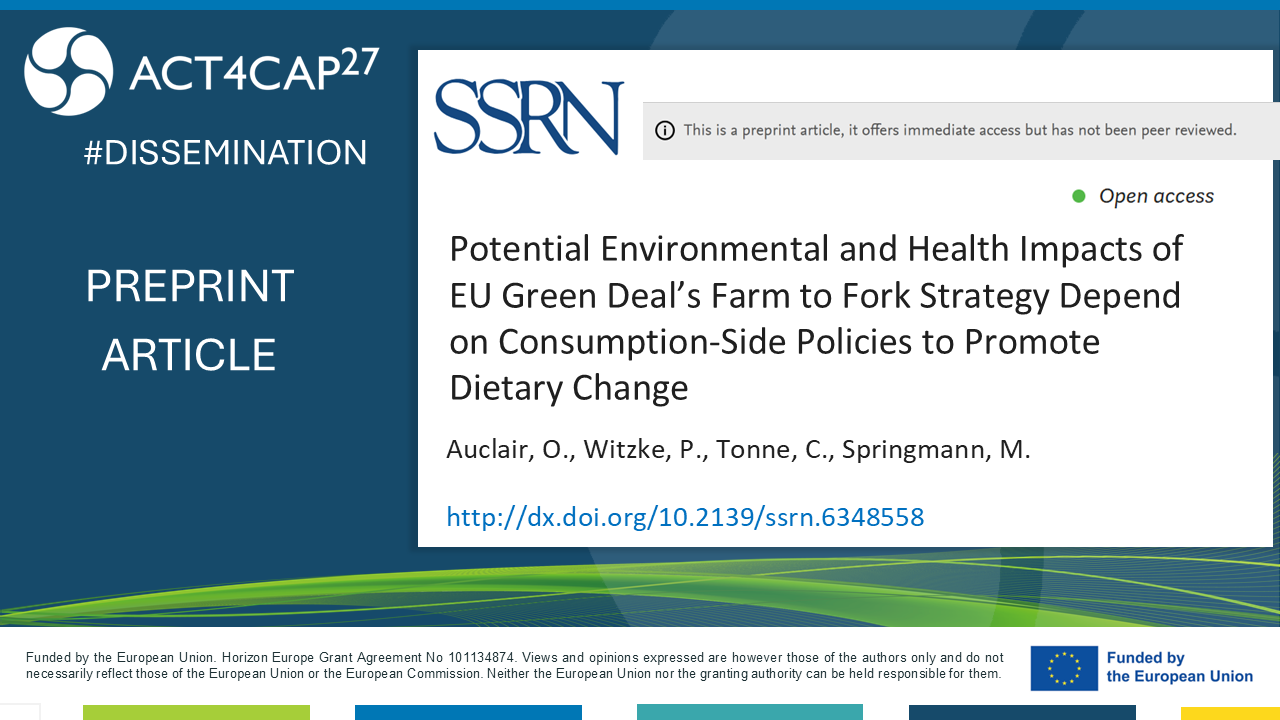
Complying with Horizon Europe requirements of early open-access sharing, a new preprint arising from research conducted with support from the ACT4CAP27 project – currently under peer-reviewing – has been published on SSRN. The study assessing the EU Green Deal’s Farm to Fork (F2F) strategy shows that production-side agricultural reforms alone deliver only limited health benefits, while large-scale gains for both climate and public health depend primarily on dietary change on the consumption side.
Using a coupled food systems and health impact modelling framework, the authors estimate that implementing F2F production policies (including reductions in fertiliser and pesticide use, expanded organic farming, and improved landscape diversity) leads to a 26% reduction in greenhouse gas emissions, but only a 0.2% reduction in premature mortality.
By contrast, scenarios that include shifts towards healthy and sustainable diets—aligned with planetary health dietary patterns—deliver substantially greater impacts:
- 11–14% reduction in total mortality by 2050 in the EU
- Up to 811,000 avoided deaths under full dietary transition scenarios
- Around 98% of health gains attributable to dietary change, not production reforms
- Major health gains driven by:
- Increased vegetable consumption
- Reduced obesity prevalence via lower energy intake
- Reduced red and processed meat intake
Environmental co-benefits are also reinforced when dietary shifts are included, with ~30% reductions in greenhouse gas emissions compared to baseline scenarios.
The study highlights significant regional variation, with the largest relative health gains observed in Eastern and Northern Europe, where baseline diet-related disease burdens are highest.
Policy relevance for ACT4CAP27
The findings strongly support the ACT4CAP27 focus on aligning Common Agricultural Policy evolution with measurable environmental and health outcomes. The study demonstrates that:
- Agricultural supply-side reforms alone are insufficient to deliver full F2F ambitions
- Demand-side dietary policy is essential to unlock systemic co-benefits
- Integrated policy design across agriculture, nutrition, and public health is required
The authors conclude that quantified consumption-side targets are urgently needed to complement existing F2F production targets and enable coherent implementation pathways for EU climate neutrality and health objectives.
Read the full preprint here: http://dx.doi.org/10.2139/ssrn.6348558