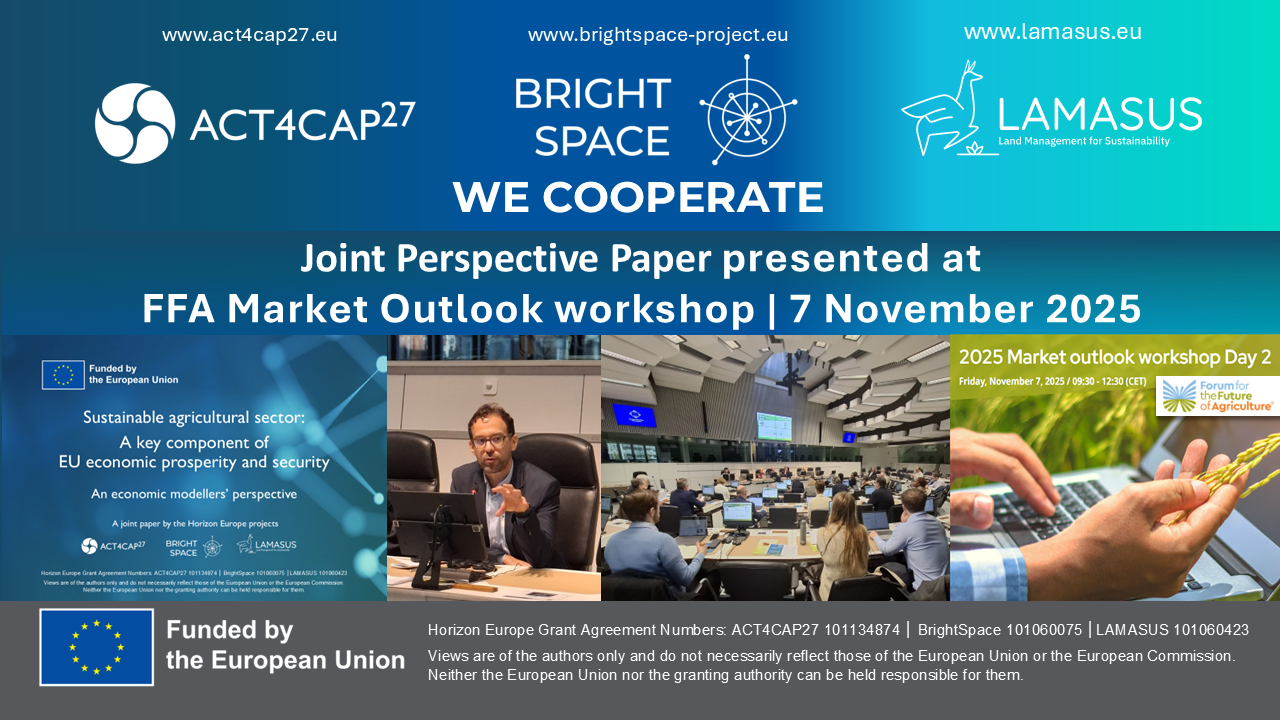
Brussels, 7 November 2025 – At the second day of the 2025 Market Outlook Workshop, hosted by the Forum for the Future of Agriculture and the Committee of the Regions in Brussels, Tamás Krisztin of the International Institute for Applied Systems Analysis (IIASA) presented the joint perspective paper developed under the LAMASUS, BrightSpace, and ACT4CAP27 projects.
His presentation, “Baseline land-use and emissions trajectories in the EU agricultural system”, offered an integrated view of the future of EU agriculture, combining insights from leading European modelling teams. The session highlighted how multi-model collaboration strengthens the evidence base for EU policy processes — particularly for assessing land use, emissions, and economic trends across the agricultural system.
Harmonised baselines for stronger policy support
The joint modelling effort aligns projections from CAPRI, GLOBIOM, MAGNET, IMAGE, and AGMEMOD, ensuring consistent macroeconomic and technological assumptions across tools. Baselines were harmonised with the European Commission’s DG AGRI macroeconomic outlook to 2035, including moderate GDP growth (+1.4% per year) and a near-stable EU population.
Results show a slight contraction in EU cropland and grassland areas — around 4 Mha of cropland and 1.4 Mha of grassland abandonment on average — while crop-specific trends vary. Compared to the Agricultural Outlook, the joint baselines suggest a narrower range of uncertainty but similar directional changes.
On emissions, EU agricultural greenhouse gas emissions are projected to decline moderately, in line with the Agricultural Outlook, though global emissions are expected to rise more sharply under the baseline assumptions.
Integrating climate and geopolitical uncertainties
Dr. Krisztin also presented how climate and geopolitical shocks are being integrated into the modelling framework. Using high-impact climate scenarios (RCP8.5) from global crop model intercomparisons, the team found that climate change is likely to slightly reduce cropland abandonment in the EU and increase agricultural exports by around 10 Mt by 2050.
Additional stressors—such as rising trade barriers, energy costs, and fertilizer prices—are also being considered to better capture the complexity of future agricultural pathways.
A joint vision for future EU policy analysis
The accompanying Joint Perspective Paper outlines key analytical priorities and opportunities from an economic modelling perspective, serving as a shared foundation for scenario development and foresight activities across the three Horizon Europe projects:
- BrightSpace (2022–2027) – Designing a Roadmap for Effective and Sustainable Strategies for Assessing and Addressing the Challenges of EU Agriculture to Navigate within a Safe and Just Operating Space.
(Coordinator: Wageningen Research) - LAMASUS (2022–2026) – Improving understanding and modelling of EU land-use management dynamics, drivers, and impacts to support European Green Deal policies.
(Coordinator: IIASA) - ACT4CAP27 (2024–2029) – Advancing key analytical frameworks (CAPRI, GLOBIOM, MAGNET, AGMEMOD) to support post-2027 agri-food policy design.
(Coordinator: Wageningen Research)
Together, these projects are improving the analytical foundations for evidence-based, forward-looking EU agri-food policy.
📄 View the presentation slides: https://doi.org/10.5281/zenodo.17590402
📄 Read the Joint Perspective Paper: https://doi.org/10.5281/zenodo.16413131
🔗 Event information: Forum for the Future of Agriculture – 2025 Market Outlook Workshop, Day 2
Source: IIASA