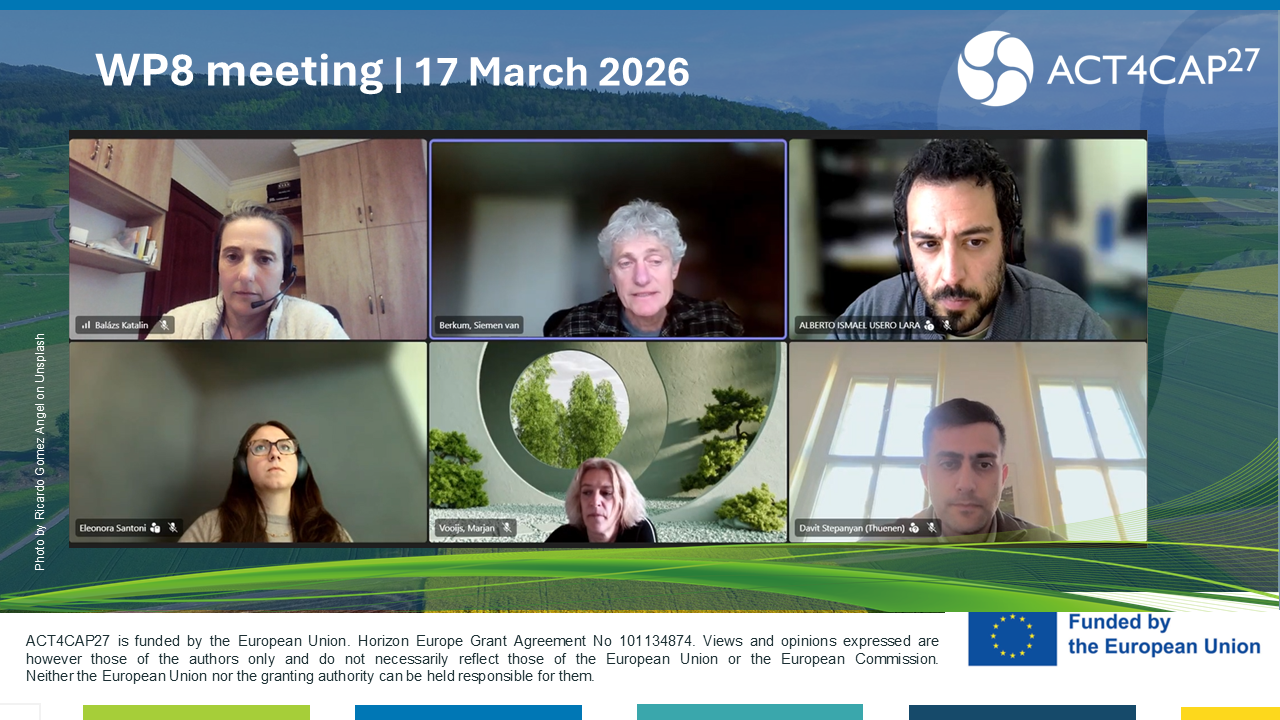
On 2 December 2025, the ACT4CAP27 consortium held its online First Reporting Period Review Meeting, gathering project partners, the European Commission, and two external reviewers to assess progress made during the first 18 months of implementation. The meeting showcased the project’s advances in building an integrated analytical and modelling toolbox to support a more sustainable, resilient, and future-oriented Common Agricultural Policy (CAP) post-2027.
Consolidated progress across the three project pillars
Pillar 1 – Designing and Assessing Sustainable EU Food Systems
Presentations highlighted a strong conceptual and analytical foundation for future work.
- A comprehensive EU food systems conceptual framework (D1.1) has been developed, mapping drivers, activities, and sustainability outcomes across environmental, economic, and social dimensions.
- A model gap analysis is underway, aligning policy needs with the capabilities of key models (MAGNET, CAPRI, AGMEMOD and GLOBIOM).
- Baseline and four fast-track scenarios — Ukraine accession, Biodiversity, Sugar Tax, and CAP Vision options — have been advanced in consultation with DG AGRI and stakeholders.
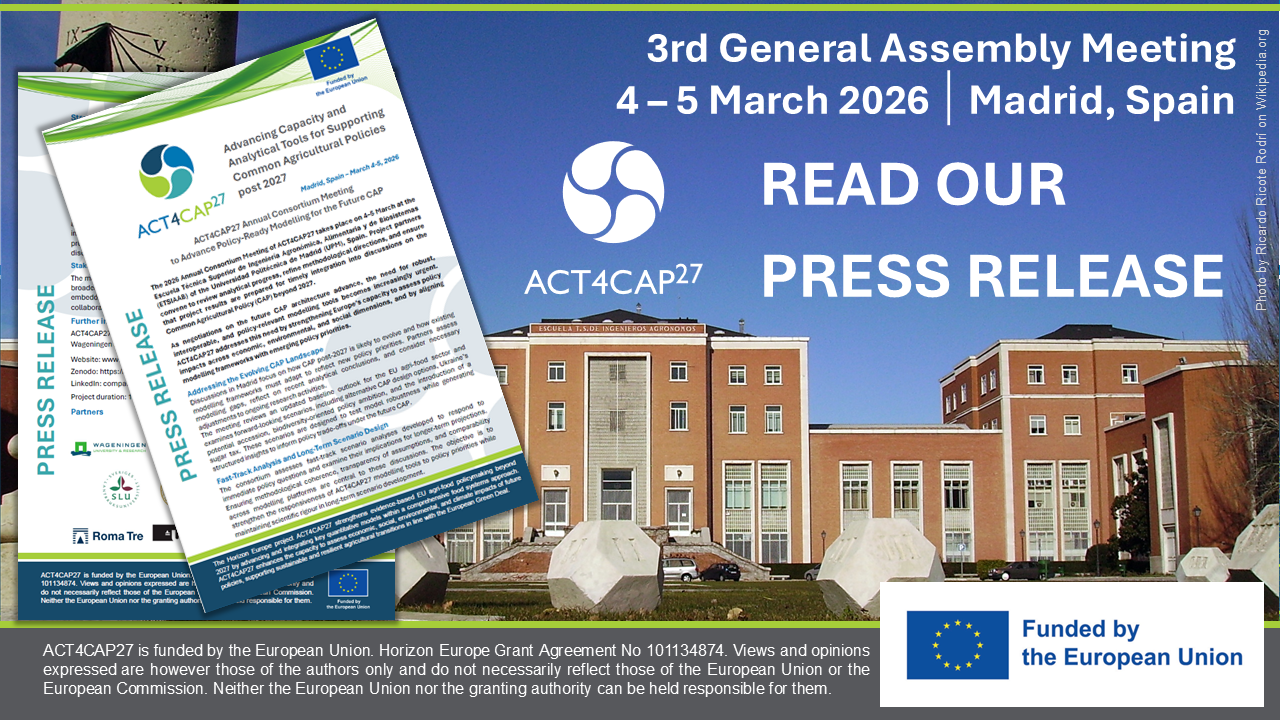
- The project contributed to policy dialogue through a reflection paper launched jointly with BrightSpace and LAMASUS, offering an economic modellers’ perspective on a sustainable EU agricultural sector.
Reviewers’ questions addressed issues such as integration of indicators, modelling gaps, and the evolving nature of CAP policies. ACT4CAP27 outlined clear mitigation strategies, including continued policy monitoring, consolidation of scenario frameworks, and strengthened alignment between conceptual work and modelling teams.
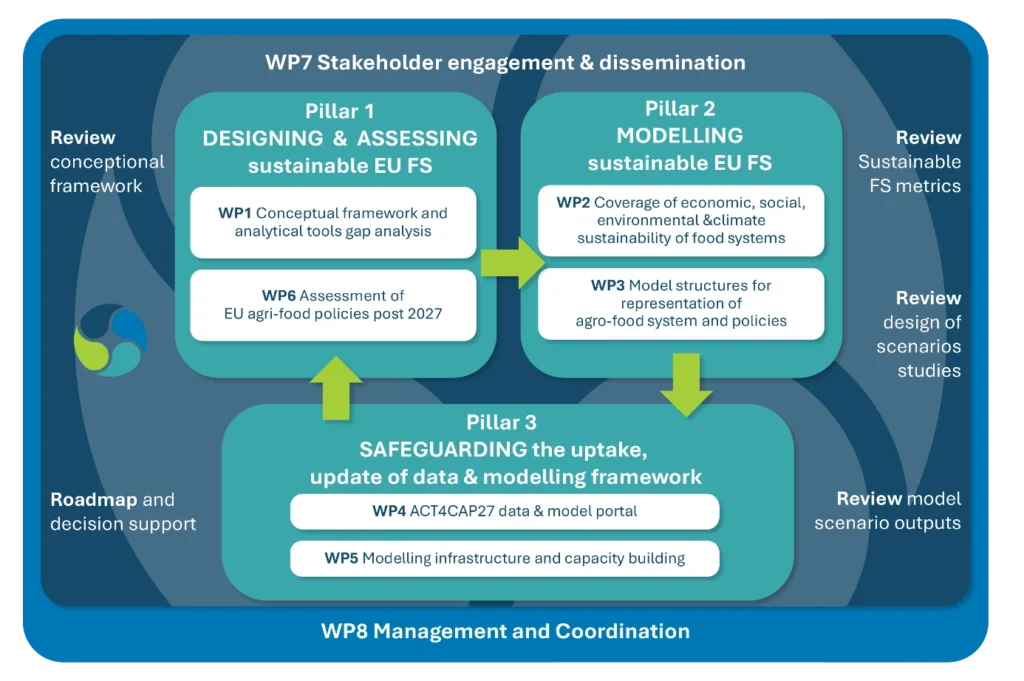
Pillar 2 – Modelling Sustainability Dimensions
Work under WP2 and WP3 is progressing on expanding model capacities to reflect the multidimensional sustainability of EU food systems.
- A health assessment module has been expanded globally, introducing age and gender disaggregation and integrating dietary impact metrics.
- Environmental modules on GHG emissions, air and water pollution, and biodiversity are being refined, with first high-resolution biodiversity outputs available.
- Socio-economic modules now include indicators for poverty, welfare, and food supply, supported by microsimulation using EU survey data.
- Advances have been made on input-use harmonisation, consumer preference modelling, and value-chain analyses.
Challenges include data harmonisation, integration of biophysical processes, and the complexity of linking diet, health, and labour productivity. Planning for RP2 prioritises improved data pipelines, enhanced model accessibility, and coordinated technical meetings to ensure cross-model compatibility.
Pillar 3 – Safeguarding, Model Infrastructure & Capacity Building
ACT4CAP27 is investing strongly in tools, data infrastructure, and community-building to ensure long-term impact.
- The ACT4CAP27 Portal on the IIASA Accelerator now hosts documentation, data-processing modules, and the first version of the Scenario Explorer, enabling cross-model data sharing and visual exploration.
- Capacity-building efforts include training for modellers (e.g. GitLab, CAPRI, AGMEMOD), the launch of the AMYRN platform, and joint initiatives with sister Horizon Europe projects.
- RP2 will focus on advancing the database prototype (D4.2), extending the Scenario Explorer, refining documentation, and implementing additional training activities including a summer school.
WP7 – Stakeholder Engagement, Communication and Dissemination
The project maintained active engagement throughout RP1:
- Two stakeholder meetings (in-person and online), targeted discussions on scenarios, and a continuously updated stakeholder database ensure balanced and inclusive outreach.
- Communication achievements include the project website, social media presence, newsletters, policy briefs, and multilingual outreach materials.
- Challenges around early-stage engagement and scheduling were mitigated through stronger cross-WP coordination and diversified outreach strategies. RP2 will scale up thematic webinars, meetings, and impact monitoring.
The review meeting demonstrated that ACT4CAP27 is firmly on track, with strong conceptual groundwork, advancing modelling innovations, and a solid infrastructure for future scenario analysis. The project continues to reinforce its ambition to provide the European Commission and wider stakeholders with robust, integrated, and policy-relevant evidence for shaping the future CAP.
The consortium expresses its sincere thanks to the EC REA Project Officer and the EC DG AGRI Policy Officer for their continuous guidance and support, and to the two external reviewers for their dedicated work and constructive critique, which will help further strengthen the project in the next reporting period.