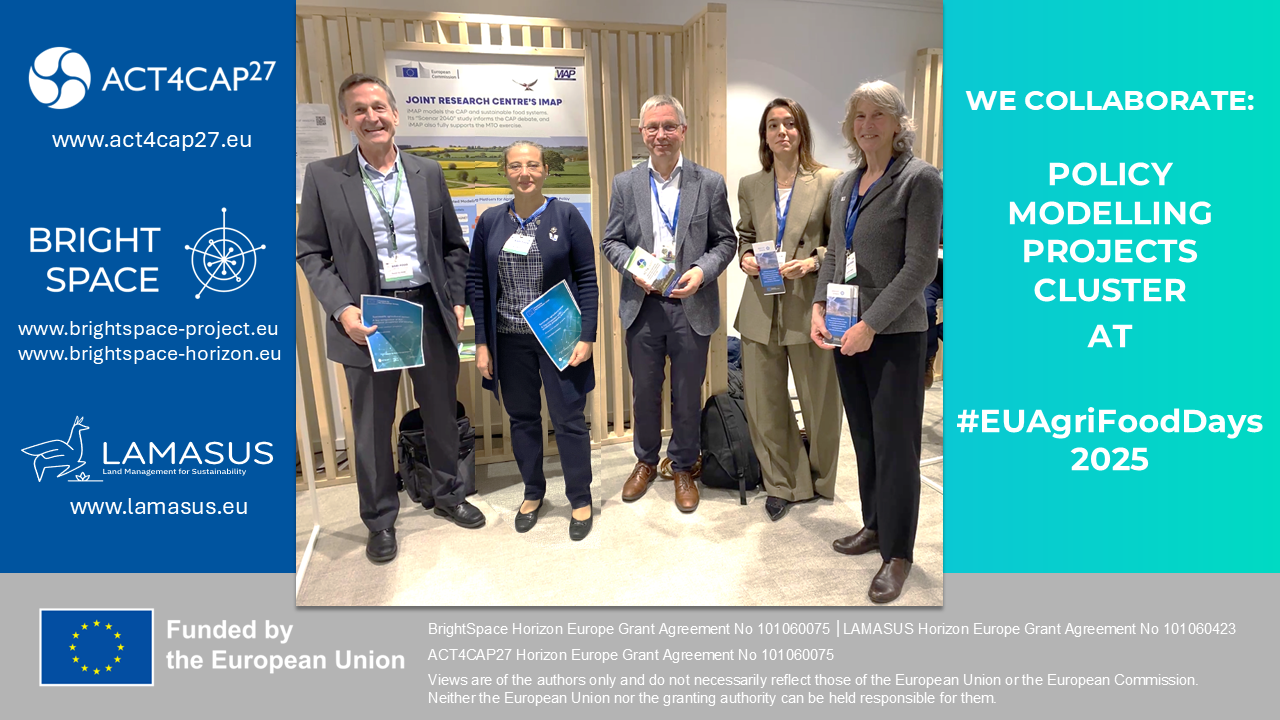
The 2025 EU Agri-Food Days brought together European institutions, Member States, farmers, agri-food businesses, researchers, and civil society to discuss how Europe can secure food production under growing uncertainty. Across two days, debates focused on food security, competitiveness, resilience, innovation, and the climate and environmental pressures shaping the future of EU agriculture. ACT4CAP27 was represented by colleagues from WSER, JRC and POS.
For ACT4CAP27, the discussions provided important signals on where EU agri-food policy debates are heading and where analytical support for post-2027 policymaking needs to be strengthened.
A shared diagnosis: rising complexity and persistent shocks
A central message throughout the EU Agri-Food Days was that volatility has become structural. Climate change, water scarcity, energy and fertiliser price volatility, geopolitical tensions, and labour shortages were repeatedly cited as long-term features of the agri-food system rather than temporary disruptions.
At the same time, the EU remains largely self-sufficient in key agricultural commodities and a major global exporter. Maintaining this position, however, increasingly depends on the capacity to anticipate and manage trade-offs between economic viability, environmental performance, climate objectives, and social outcomes, including food affordability and public health.
This evolving context underscores the growing need for robust, integrated, and forward-looking policy modelling, a core objective of ACT4CAP27.
Beyond single-policy lenses: the need for integrated food system analysis
Discussions at the EU Agri-Food Days made clear that agricultural policy can no longer be assessed in isolation. Climate mitigation and adaptation, energy dependency, trade exposure, consumer behaviour, and health outcomes are now firmly part of the agri-food policy landscape.
ACT4CAP27 directly addresses this challenge by adopting a comprehensive food system approach. The project strengthens the quantitative assessment of upcoming agri-food policies post-2027 across:
- economic impacts,
- social impacts (including health),
- environmental outcomes,
- and climate sustainability.
By systematically identifying synergies, trade-offs, and cross-sectoral linkages, ACT4CAP27 supports more coherent regulatory pathways in a context of ongoing shocks and global disruptions.
Strengthening the analytical foundations of EU agri-food policymaking
The EU Agri-Food Days highlighted the importance of credible evidence to support policy choices under uncertainty. ACT4CAP27 contributes to this need by enhancing the analytical capacity of key policy modelling tools used by the European Commission, including CAPRI, GLOBIOM, MAGNET, and AGMEMOD.
Rather than developing entirely new models, the project focuses on:
- improving consistency across modelling frameworks,
- extending their ability to capture sustainability dimensions,
- and strengthening their capacity to analyse future policy scenarios beyond 2027.
This work is supported by a consistent, interdisciplinary methodological framework, designed to operationalise complex aspects of the EU agri-food system in a transparent and comparable way.
The ACT4CAP27 Modular Toolbox: enabling collaboration and innovation
A key innovation of ACT4CAP27 is the development of the ACT4CAP27 Modular Toolbox for EU Food System Modelling. The toolbox addresses limitations of existing modelling approaches by creating a shared, modular, and collaborative technical infrastructure for the European agri-food research and policy modelling community.
The toolbox:
- enables the integration of new modules and data sources,
- supports collective model development and experimentation,
- and provides a foundation for innovation in policy impact assessment.
In doing so, ACT4CAP27 strengthens Europe’s capacity to respond analytically to emerging policy questions and complex sustainability challenges.
The role of stakeholder input in shaping modelling questions
The EU Agri-Food Days also illustrated the diversity of perspectives across the agri-food system. Farmers, processors, retailers, consumers, environmental organisations, innovators, scientists, and policymakers often experience policy impacts differently, and these differences are not always visible in quantitative models alone.
ACT4CAP27 therefore places strong emphasis on stakeholder engagement as a means to improve policy modelling relevance. Through its Dissemination and Stakeholder Platform, the project invites stakeholders from across the agri-food chain to contribute by identifying:
- the most pressing policy questions requiring quantitative assessment,
- areas where trade-offs and distributional effects are insufficiently understood,
- and data gaps or uncertainties that matter most for future policy decisions.
These inputs help guide scenario design and modelling priorities, ensuring that analytical work remains closely connected to real-world challenges while remaining transparent about data availability and limitations.
From modelling to policy guidance
Going beyond technical modelling, ACT4CAP27 is developing an Interactive Roadmap for Policy Guidance. This tool is designed to support EU, national, and regional policymakers in navigating complex policy choices by:
- comparing alternative policy pathways,
- weighing competing objectives,
- and assessing their implications for sustainability outcomes.
In this way, ACT4CAP27 contributes to more informed, transparent, and evidence-based agri-food policymaking beyond 2027.
Looking ahead
The EU Agri-Food Days confirmed that future agri-food policies will need to operate in a far more complex and uncertain environment than in the past. For ACT4CAP27, this reinforces the importance of strengthening analytical capacity, improving modelling coherence, and fostering collaboration across the policy modelling community.
As the project progresses, insights from EU-level policy debates such as the Agri-Food Days will continue to inform our analytical focus, stakeholder engagement, and tool development — supporting more robust and sustainable agri-food policy pathways for Europe after 2027.
Source: POS / WSER / JRC