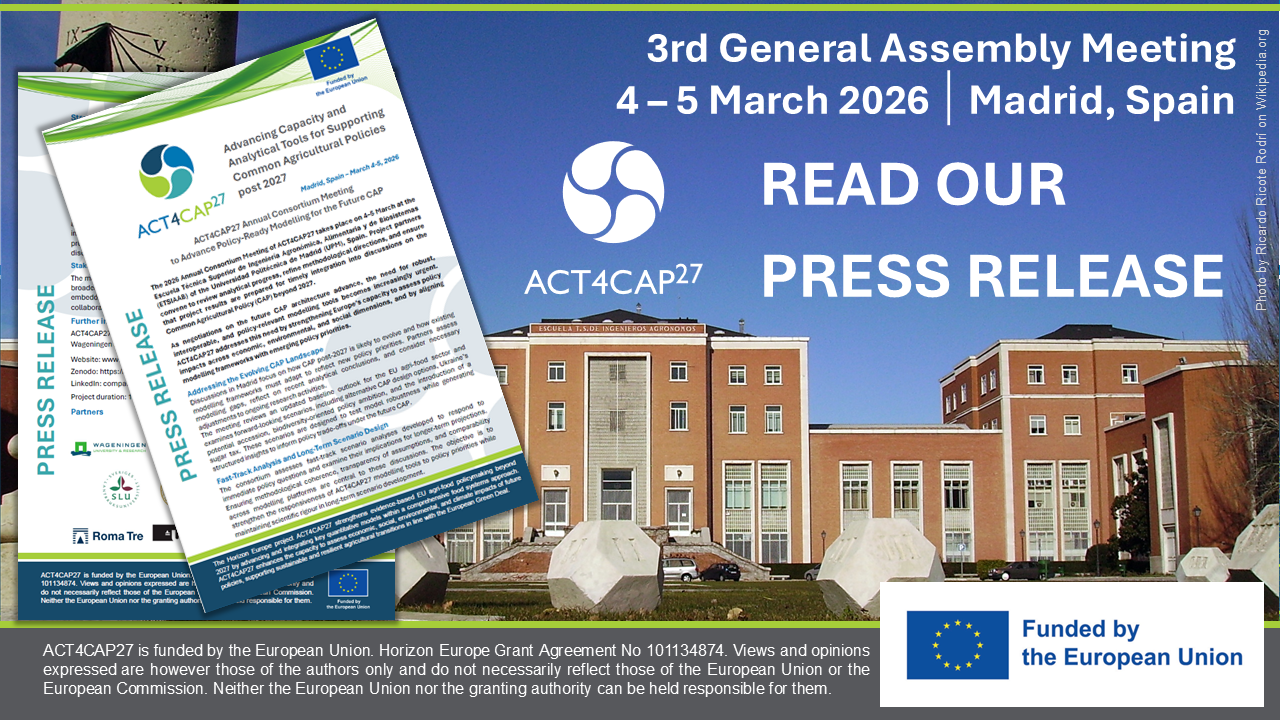
The ACT4CAP27 consortium has officially started its Annual Meeting on 4 March 2026 at the Escuela Técnica Superior de Ingeniería Agronómica, Alimentaria y de Biosistemas (ETSIAAB) of the Universidad Politécnica de Madrid, bringing together project partners for two days of strategic discussions on the future of the Common Agricultural Policy (CAP) beyond 2027.
The consortium is moving from foundational design and fast-track scenario testing toward deeper model integration, policy alignment, and exploitation of results.
Setting the Direction: CAP Post-2027 and Modelling Gaps
The morning sessions were anchored in Deliverable 1.2, which examines likely trajectories of the CAP after 2027 and identifies modelling gaps across economic, environmental, and social domains. Discussions emphasized that future CAP analysis must go beyond modelling policy intentions and instead represent delivery realities—including heterogeneous implementation across Member States, administrative capacity constraints, and uptake dynamics.
A structured review of seven key modelling gaps followed, covering CAP instruments and indicators, pollution and input use, greenhouse gas accounting approaches, biodiversity measurement, consumption and healthy diets, value-chain representation, and farm income and social well-being. Most gaps are being addressed through new modules, including a CAP policy instrument database, environmental assessment tools, consumer preference modelling, biodiversity indicators, and socio-economic assessment extensions. The integration of additional tools such as IMFCAP will strengthen farm income analysis.
The overarching objective is clear: improve indicator coverage and transparency while maintaining model robustness and coherence with the project’s original mandate.
Building the Common Baseline
A major milestone discussed was the development of the ACT4CAP27 harmonised baseline. This baseline will serve as the common reference scenario for all medium- and long-term policy assessments. It builds on previous modelling efforts (including LAMASUS and BrightSpace) and integrates stakeholder input to ensure policy relevance.
Key open questions include alignment with DG AGRI macroeconomic assumptions, integration of CAP Strategic Plans at Member State level, treatment of climate assumptions, and incorporation of external drivers such as CBAM and EU ETS impacts on fertilizer prices. The baseline is conceived not merely as a technical reference case, but as a transparent analytical foundation enabling comparable cross-model scenario work.
Fast-Track Scenarios: From Biodiversity to Digitalisation
The afternoon sessions focused on fast-track scenario results and methodological advancements.
Biodiversity and Climate Synergies. A cross-model comparison between CGE and partial equilibrium frameworks assessed policy mixes combining biodiversity restoration, carbon pricing, and mitigation technology adoption. Results indicate that combining technology adoption with biodiversity protection can achieve substantial emission reductions while minimizing negative impacts on agricultural production. The analysis also highlighted structural differences between modelling frameworks, particularly regarding economy-wide feedbacks and trade adjustments.
Digitalisation and Competitiveness. The digitalisation scenario explored the impacts of AI, IoT, precision agriculture, and drone technologies. Preliminary results show strong productivity gains and input cost reductions under high adoption assumptions, with significant implications for farm income and competitiveness. Sensitivity analyses and further refinement of technology databases are underway.
Ukraine Accession Scenario. The consortium reviewed updated baseline and accession pathways for Ukraine, modelling integration into EU agricultural markets under different recovery and CAP implementation assumptions. The analysis quantifies implications for production, trade flows, self-sufficiency, and budget allocations under alternative EU27 and EU28 configurations.
Sugar Tax Scenario. The WP6 sugar reduction scenario demonstrated how achieving the Planetary Health Diet threshold would require structural dietary change, with significant spillover effects along agricultural value chains. While the scenario will not receive full-scale expansion, it continues to inform food-system modelling and demand-side integration.
Strengthening Infrastructure and Governance
A dedicated session showcased progress on the IIASA Accelerator Platform, which enables harmonised data management, model coupling, and reproducible scenario workflows. The modular architecture and AI-assisted data explorer are central to linking new modules with core models and supporting multi-scenario comparison.
The day concluded with a discussion on ethical considerations in modelling and policy assessment, reinforcing the project’s commitment to responsible innovation and transparency.
Moving Forward
Day 1 confirmed that ACT4CAP27 is entering a phase of operational integration. Fast-track scenarios are identifying modelling gaps, new modules are under development, and a detailed post-2027 CAP database is being built to support robust scenario design.
The final scenarios are scheduled for delivery by February 2027, with model refinement continuing thereafter. Day 2 will focus on exploitation, stakeholder engagement planning for 2026, and small-group technical sessions.
📢 Read our press release (available in English and Spanish) on the ACT4CAP27 Zenodo Community page for more background on the meeting and project developments.
🔗 Press release – English version: https://doi.org/10.5281/zenodo.18863391
🔗 Press release – Spanish version: https://doi.org/10.5281/zenodo.18863582