To strengthen capacity-building efforts, the ACT4CAP27 project maintains the Agricultural Model Young Researcher Network (AMYRN). This initiative supports the development of a network of young researchers, particularly PhD candidates and early-career postdocs, who are interested in using modelling approaches to inform agricultural policies. Through AMYRN, researchers gain practical experience with key agricultural models such as AGMEMOD, CAPRI, GLOBIOM, MAGNET and IFM-CAP, which are widely used for large-scale land use, biodiversity, climate change, and food security assessments. The program facilitates short-term research stays at ACT4CAP27 partner institutes, collaboration with modelling experts, and participation in specialized training programs.
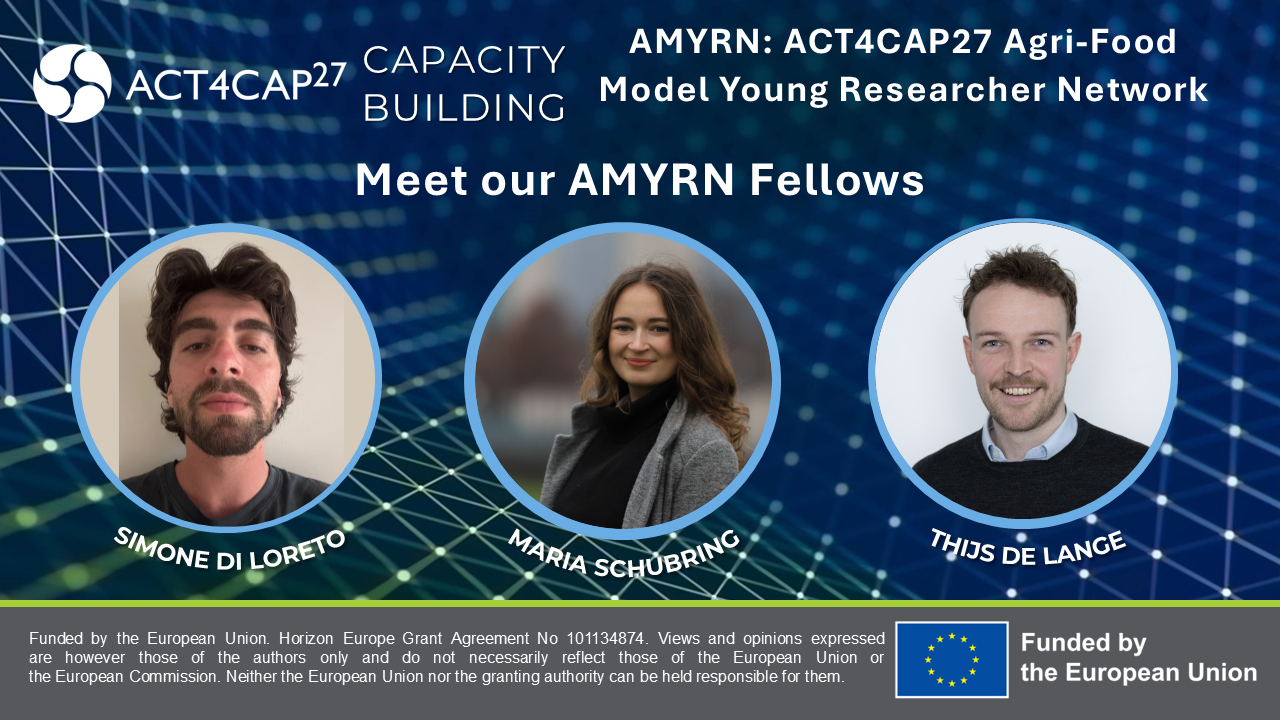
So far three AMYRN fellowships were awarded, supporting young researchers in their efforts to enhance modelling expertise and contribute to ACT4CAP27 research activities.
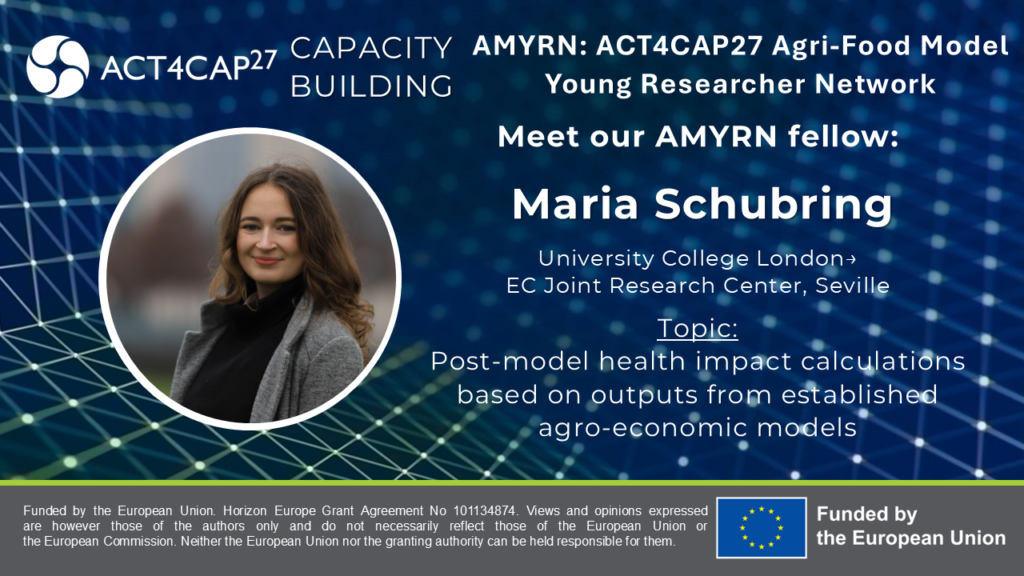
Maria Schubring, Global Health Modeler (Research Assistant) at University College London (UCL) – 4-month exchange at EC JRC Seville, ES
Maria Schubring, Global Health Modeler at University College London (UCL), completed a three-month exchange in May 2026 under the ACT4CAP27 Agri-food Model Young Researchers Network (AMYRN) hosted by the European Commission Joint Research Centre (JRC), Seville, under the supervision of Dr. Marco Springmann and Dr. Thomas Fellmann.
The exchange took place within JRC Seville’s iMAP modelling platform, focusing on integrating health dimensions into agro-economic modelling frameworks. Work centred on developing post-model health impact calculations based on CAPRI and MAGNET outputs, building on the Dietary Impact Assessment (DIA) model developed at UCL.
A key outcome was the design of a complete workflow for the CAPRI and Health module link in the IIASA’s Accelerator platform with support from IIASA colleague, Rupesh Singh to translate dietary scenario changes into quantified health and cost impacts, enabling application across multiple modelling frameworks within ACT4CAP27. In the next months this workflow link will also be projected to the MAGNET model.
The work contributes to WP2 and WP3, supports Deliverable D1.3, and strengthened sustainability assessment by improving the integration of health metrics into agro-economic modelling. It is expected to support a joint scientific publication and advance a more standardised approach to health impact evaluation across models.
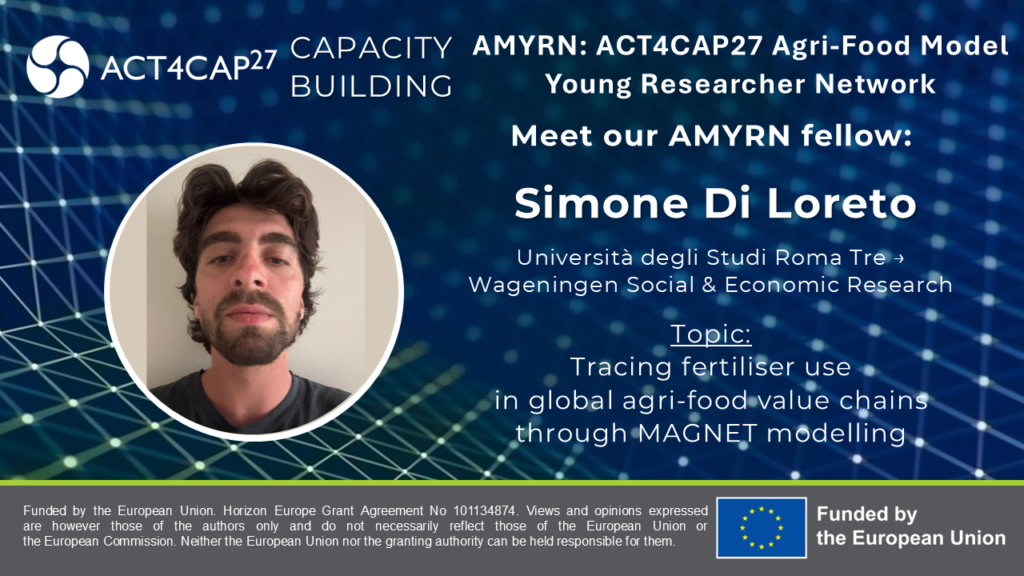
Simone Di Loreto, PhD candidate at the Università degli Studi Roma Tre – 6-month exchange at Wageningen Social & Economic Research (WSER), NL
Simone Di Loreto, PhD candidate at the Università degli Studi Roma Tre, started a six-month research visit at Wageningen Social & Economic Research (WSER), The Hague Office, in May 2026 under the ACT4CAP27 Agri-food Model Young Researchers Network (AMYRN), supervised by ACT4CAP27 project coordinator Siemen Van Berkum.
The work focuses on improving the representation of fertiliser use in the MAGNET model, including calibration of input intensities and consistency across production structures, with attention to substitution between fertilisers, land and intermediate inputs. A Leontief-based input–output decomposition is applied to trace direct and indirect fertiliser use across global agri-food value chains, strengthening input footprint analysis in trade flows. Scenario analysis includes a 20% reduction in EU fertiliser use, assessing impacts on production, trade and environmental indicators, with an optional exploration of a fertiliser-based border adjustment mechanism (FBAM).
The exchange contributes to WP3 Task 3.3 and supports WP6 policy analysis, with expected outputs including an enhanced MAGNET framework, scenario results, and a joint working paper..
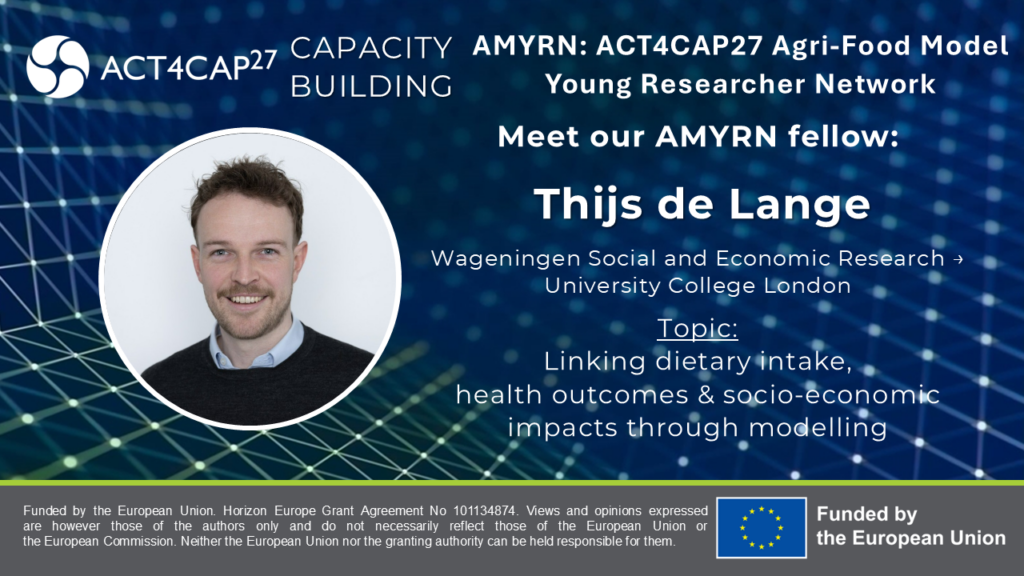
Thijs de Lange, PhD Student Wageningen Social & Economic Research (WSER), – 2-month exchange at University College London (UCL), UK
Thijs de Lange, junior researcher and external PhD candidate at Wageningen Social and Economic Research (WSER), participated in an exchange at University College London (UCL) earlier in 2026, under the supervision of Marco Springmann.
The exchange was embedded in WP2 Task 2.1, focusing on the development of a health module linking dietary intake, disease outcomes and socio-economic impacts. Work supported strengthening the conceptual and analytical basis for integrating dietary patterns with health and social sustainability dimensions.
Thijs’ activities focused on advancing a conceptual framework for dietary health and well-being, incorporating indicators such as disability-adjusted life years (DALYs) alongside labour productivity, health expenditure and broader social costs. The framework supported integration of health impacts into economic modelling, including applications in MAGNET.
The exchange contributed to model development under Task 2.1 and is expected to support a joint scientific publication and further refinement of the health-modelling interface within ACT4CAP27.
The AMYRN fellowships demonstrate ACT4CAP27’s commitment to fostering the next generation of agricultural modelers. By supporting these research exchanges, the project strengthens collaboration among partner institutes, enhances modelling capabilities. These fellowships not only advance individual research careers but also reinforce the ACT4CAP27 network’s collective expertise in agricultural policy modelling.