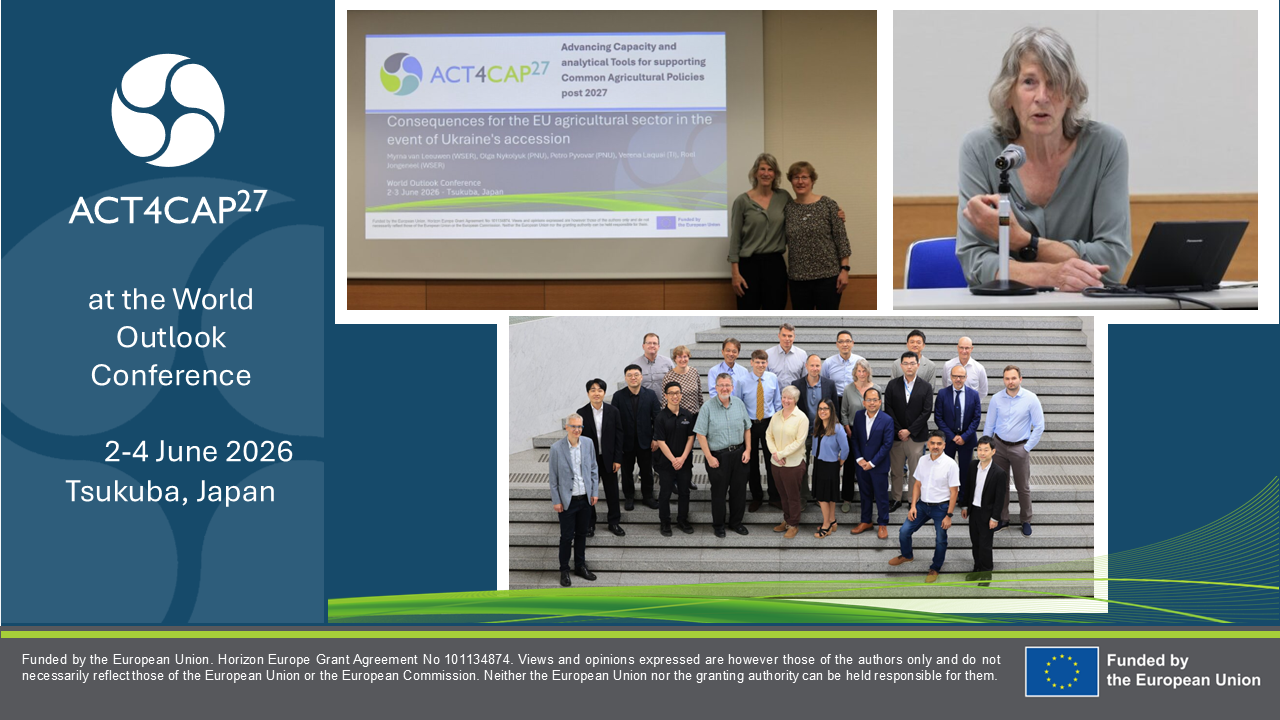
From 2–4 June 2026, the World Outlook Conference convened in Tsukuba, Japan, bringing together leading international organisations and research institutes working on agrifood outlooks. Participants included the OECD, FAO, FAPRI (United States), PRIMFF (Japan), the European Commission, the Kiev School of Economics (Ukraine), Wageningen University & Research, and the Thünen Institute, among others. The conference provided a structured platform for the exchange of evidence-based insights on emerging trends and structural challenges affecting global agrifood markets, and for exploring avenues for strengthened international collaboration.
Key thematic priorities this year centred on global food security, market resilience, and the geopolitical drivers shaping agrifood systems. Particular attention was given to the implications of ongoing conflicts, including the war in Ukraine and tensions in the Middle East, and their cascading effects on production systems, trade flows, and price volatility. Discussions also addressed longer-term uncertainty in global supply-demand balances and the need for improved foresight capacity across regions.
Within this context, Myrna van Leeuwen (WSER) and Verena Laquai (Thünen) presented work developed under the ACT4CAP27 project, focusing on the implications of hostilities for agrifood outlooks in Ukraine and the European Union. The contribution examined how conflict-related disruptions may affect medium- to long-term projections of agricultural production, trade dynamics, and policy responses, including under scenarios in which Ukraine may accede to the European Union. The presentation contributed to broader discussions on how integrated modelling and scenario analysis can support more robust agrifood foresight under conditions of heightened uncertainty.
The exchange reinforced the importance of continued international cooperation in agrifood outlook development and highlighted the value of connecting regional analytical approaches with global forecasting frameworks. It also underlined the relevance of the Horizon Europe supported research in ACT4CAP27 in supporting evidence-based policy discussions on food system resilience and future structural change.
Source: WSER