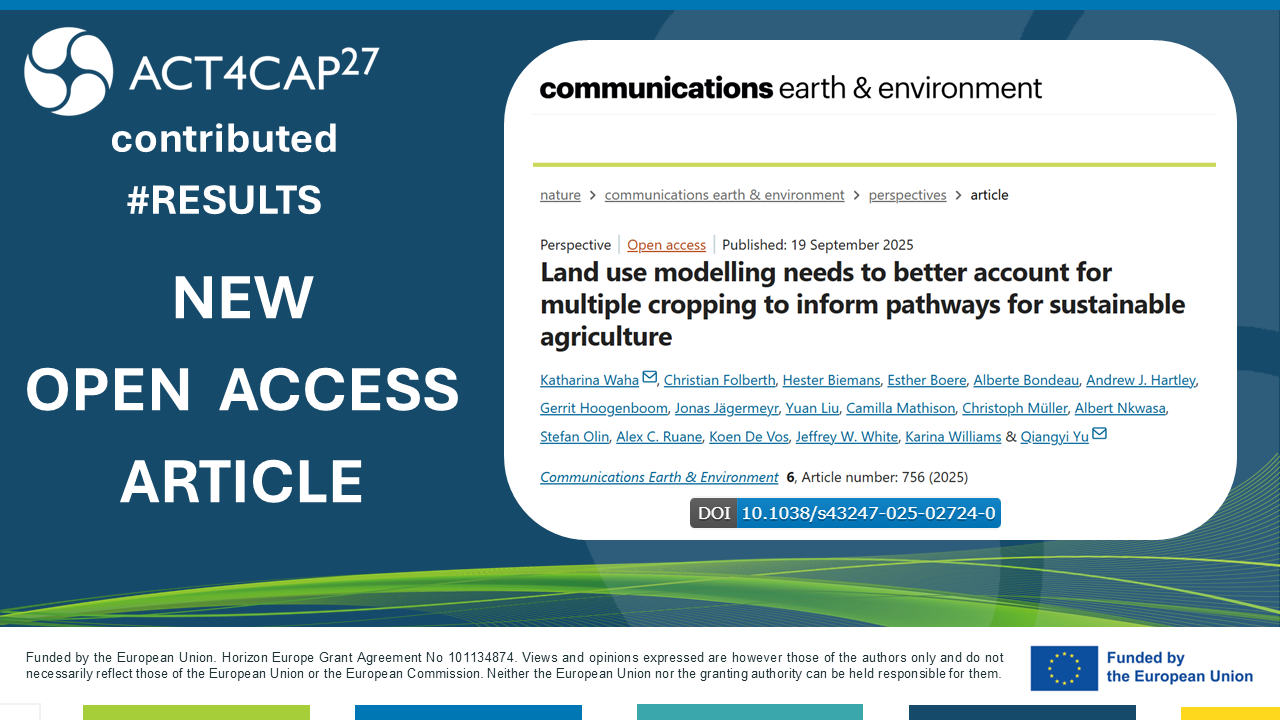
We are pleased to announce the publication of a new open-access scientific article (19 September 2025) in Communications Earth & Environment that directly supports the objectives of ACT4CAP27. Several co-authors from the International Institute for Applied Systems Analysis (IIASA), who are also contributors to the ACT4CAP27 project, took part in this work.
What the study shows
The study demonstrates that many widely used large-scale agri-food and land-use models systematically under-represent multiple cropping systems – the practice of cultivating more than one crop per year on the same land. This simplification can lead to biased projections of yields, land demand, input use, environmental pressures and production costs, ultimately affecting the reliability of scenario results used in policy design.
By introducing a more realistic treatment of cropping intensity, the authors show that model outcomes can change significantly, especially regarding production potential, trade-offs between productivity and sustainability, and estimates of land pressure. This has important implications for improving the scientific foundations of policy-relevant modelling.
Why this matters for ACT4CAP27
ACT4CAP27 addresses the need for improved data and modelling tools by advancing key analytical frameworks — CAPRI, GLOBIOM, MAGNET and AGMEMOD — to better support evidence-based post-2027 EU agri-food policies. The findings of this study highlight a concrete methodological gap and provide practical guidance for strengthening how cropping intensity is represented in these types of models, contributing directly to ACT4CAP27’s goal of more robust, transparent and policy-relevant analytical tools.
🔓 Open access and repository
The article is available open access via Communications Earth & Environment and has also been deposited in the ACT4CAP27 Zenodo Community, part of the EU Open Research Repository.
🔗 Read the full article: https://doi.org/10.1038/s43247-025-02724-0
🔗 Visit the ACT4CAP27 Zenodo Community page: https://zenodo.org/communities/act4cap27-eu-project/
We congratulate all co-authors — including our ACT4CAP27 colleagues — on this important contribution.