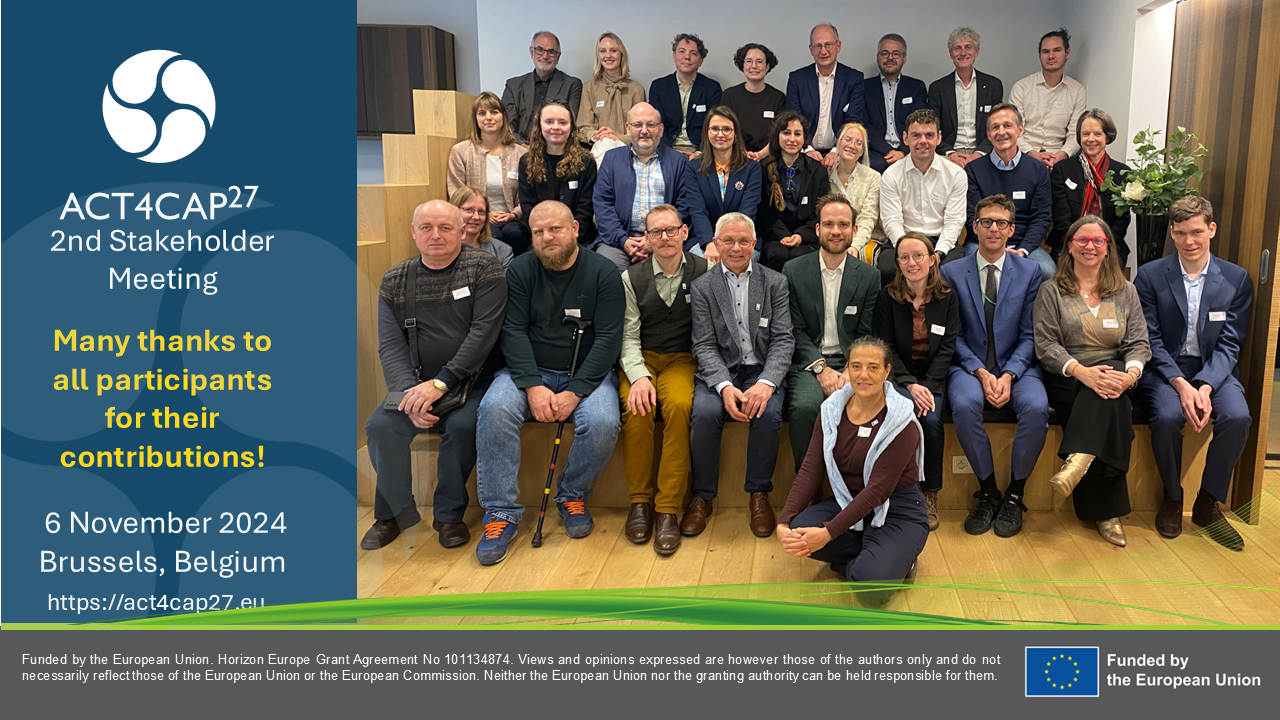
The ACT4CAP27 project held its Second Stakeholder Meeting in Brussels on 6 November 2025, bringing together project partners, researchers, policymakers, and modelling experts to discuss how advanced agri-economic models can better support the design and implementation of the Common Agricultural Policy (CAP) post-2027.
Setting the Scene
Opening remarks welcomed participants to a day focused on strengthening analytical tools for evidence-based agricultural policymaking. The discussion centred on how models can help policymakers respond to evolving CAP challenges in a changing policy and market environment.
Policy Developments and Modelling Implications
In his keynote address, Prof. Emeritus Alan Matthews (Trinity College Dublin) explored the increasing complexity of the CAP and its implications for modelling.
He highlighted:
- Growing Member State flexibility and a potentially less “common” policy framework.
- Budgetary uncertainties linked to the next Multiannual Financial Framework.
- New targeting of direct payments and adjustments to green architecture and conditionality.
These trends demand models capable of addressing policy heterogeneity, regional diversity, and data-driven performance monitoring to ensure policy relevance in the next CAP cycle.
ACT4CAP27 in Context
Project coordinator Siemen van Berkum (Wageningen Social and Economic Research) presented how ACT4CAP27 is building an integrated modelling toolbox linking MAGNET, CAPRI, AGMEMOD, and GLOBIOM.
Progress to date includes developing a sustainability indicator framework, advancing thematic modules (health, environment, socio-economic), and introducing structural improvements to better reflect consumer preferences, input use, and supply chain dynamics.
Case studies — including an AGMEMOD Ukraine module — explore how geopolitical and market developments intersect with EU agri-food systems.
Making Future-Ready Models
A joint session led by Verena Laquai and Karen Arcia Pérez (Thünen Institute), Roel Jongeneel (WSER), and Tobjorn Jansson (SLU) reviewed how models can be made more responsive to future CAP requirements.
Key recommendations included:
- Coupling existing models with behavioural and agent-based approaches.
- Establishing data interoperability standards for transparency and reproducibility.
- Expanding indicators to reflect social equity, health, and value-chain impacts alongside environmental and economic outcomes.
- Ensuring CAP sustainability objectives are traceable from policy instrument to model indicator.
Examples of future applications demonstrated how ACT4CAP27 models can inform policy decisions on market effects, sustainability, biodiversity, and competitiveness under varying CAP reform scenarios.
Panel Discussion: Bridging Science and Policy
A high-level panel featuring Léon Van de Pol (DG AGRI), Hans van Meijl (WUR), Alan Matthews (TCD), and Thomas Fellmann (JRC) discussed how modelling can effectively support the next CAP.
The panel emphasized the need for collaboration, transparency, and clear communication of model assumptions to ensure that models are not only technically robust but also usable for policy design under uncertainty.
Next Steps
In his closing remarks, Siemen van Berkum outlined the next phase of stakeholder engagement:
- 2026 thematic seminars will discuss fast-track scenario results on input use, Ukraine, biodiversity, productivity, and trade.
- 2026–2028 stakeholder meetings (online and in-person) will review baseline and policy scenario results.
- The 3rd Stakeholder Meeting is planned for spring 2026, focusing on the first policy impact assessments.
Takeaway
The meeting reaffirmed ACT4CAP27’s mission: to build robust, flexible, and transparent modelling frameworks that bridge scientific innovation and policymaking. By strengthening the link between model evidence and CAP reform, ACT4CAP27 supports the development of a sustainable, resilient, and performance-oriented agricultural policy for Europe.
We thank all participants for their valuable insights and active engagement.
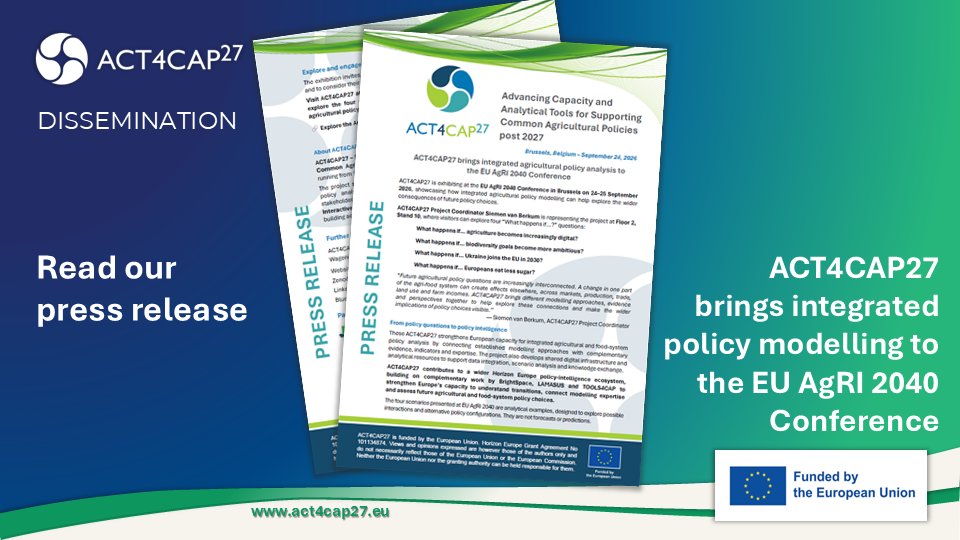
📄 Read our official press release here: https://doi.org/10.5281/zenodo.17545959